The World’s Most Powerful AI Data Centers: Colossus 2 Takes the Lead as Gemini, Claude and Llama Infrastructure Enters the Top Five
A look at the giant U.S. computing facilities behind Grok, OpenAI, Microsoft Copilot, Gemini, Claude and Llama.
As frontier AI models demand more computing power, how far has the infrastructure beneath them actually developed?
In other words: which AI data center is now the most powerful in the world?
Research organization Epoch AI tracks major AI data centers using satellite imagery, regulatory filings, company disclosures, chip performance and power infrastructure. Its estimates make it possible to compare facilities that use very different types of AI hardware.
The original ranking covered 60 facilities. As new projects have come online and estimates have been revised, Epoch AI’s database now includes 83 large AI data centers. The current top five are all in the United States and are linked to products familiar to American users—including Grok, OpenAI services, Microsoft Copilot, Gemini, Claude and Llama.
How Can Different AI Chips Be Compared?
Epoch AI converts different accelerators into H100-equivalent compute, abbreviated H100e. Some facilities use NVIDIA H100 or H200 GPUs, others have moved to B200 and B300 systems, while Google and Amazon rely heavily on their own TPU and Trainium chips.
Simply counting chips would be misleading. A B300 is considerably more powerful than an H100, and the architecture of a Google TPU or Amazon Trainium processor is different from an NVIDIA GPU. Epoch AI therefore uses 8-bit computing performance and other technical assumptions to estimate how many H100 GPUs would be needed to provide comparable performance.
| Rank | Data Center | Owner / Users | H100e | IT Power |
|---|---|---|---|---|
| 1 | Colossus 2, Memphis | SpaceXAI, Anthropic, Cursor | 1.112M | 946 MW |
| 2 | Fairwater Atlanta, Georgia | Microsoft, likely OpenAI | 769K | 636 MW |
| 3 | Google Pryor North, Oklahoma | Google, possibly DeepMind | 763K | 368 MW |
| 4 | Amazon New Carlisle, Indiana | Amazon, Anthropic | 686K | 910 MW |
| 5 | Meta Prometheus, Ohio | Meta | 677K | 562 MW |
No. 1: Colossus 2 — SpaceXAI’s Computing Giant
Located in Memphis, Tennessee, Colossus 2 currently provides an estimated 1.112 million H100e, supported by 946 MW of IT power. Epoch AI estimates its capital cost at $35.8 billion.
The facility is estimated to contain roughly 110,000 NVIDIA B200 GPUs and 330,000 B300 GPUs. That is about 440,000 physical accelerators—but their greater performance produces more than one million H100 equivalents.
Colossus became famous as the infrastructure behind xAI’s Grok. Epoch AI now also lists Anthropic and coding platform Cursor among Colossus 2’s users. To bring power online quickly, SpaceXAI developed gas generation, substations and cooling infrastructure near the Tennessee-Mississippi border.
Projected Q1 2027
1.824 million H100e and more than 1.5 GW of IT power
No. 2: Microsoft Fairwater Atlanta — An AI Superfactory for OpenAI and Copilot
Microsoft Fairwater Atlanta in Fayetteville, Georgia, has an estimated 769,000 H100e, 636 MW of IT power and a capital cost of about $24.1 billion. Epoch AI estimates that it uses approximately 304,300 NVIDIA B200 GPUs.
Built by QTS and leased by Microsoft, the campus forms part of Microsoft’s AI WAN. Microsoft has connected its Atlanta and Wisconsin Fairwater sites so they can operate more like one distributed AI supercomputer. The infrastructure likely supports demanding Microsoft and OpenAI workloads, including the ecosystem behind Copilot, Azure AI and OpenAI services.
No. 3: Google Pryor North — The TPU Route Behind Gemini
Google’s Pryor facility in Oklahoma provides an estimated 763,000 H100e with only 368 MW of IT power, at an estimated capital cost of $13.9 billion.
Unlike the top two sites, Pryor is believed to rely mainly on Google-designed TPU v5p and TPU v5e accelerators. TPUs are central to Google’s AI infrastructure and the broader Gemini ecosystem. Epoch AI marks direct DeepMind use as possible rather than confirmed, so the facility should not be described as serving only Gemini.
No. 4: Anthropic–Amazon New Carlisle — Claude’s Trainium Base
The New Carlisle campus in Indiana is a core part of Amazon and Anthropic’s Project Rainier. It currently provides about 686,000 H100e, supported by 910 MW of IT power, with an estimated capital cost of $34.5 billion.
Epoch AI estimates that the site contains more than one million Amazon Trainium2 chips. Anthropic, the developer of Claude, is one of AWS’s most important AI partners. The site’s physical chip count exceeds one million, yet its H100e score remains below Fairwater and Pryor—another reminder that chip counts alone do not measure total performance.
With future buildings and Trainium3 hardware, Epoch AI projects New Carlisle could reach roughly 1.746 million H100e by early 2028.
No. 5: Meta Prometheus — Computing for Llama and Meta AI
Meta Prometheus in New Albany, Ohio, currently provides about 677,000 H100e with 562 MW of IT power and an estimated cost of $21.3 billion. It primarily uses NVIDIA B200 hardware.
Meta is rapidly expanding infrastructure for Llama, Meta AI, recommendation systems and advertising. Prometheus is unusual because it combines conventional data center buildings, colocation facilities and temporary modular structures—more like a computing city being expanded while it operates.
Epoch AI projects the site could grow to approximately 1.031 million H100e and 854 MW of IT power by early 2027.
Why Does the United States Hold All Five Top Spots?
The answer is not just that the United States is home to Microsoft, Google, Amazon, Meta, OpenAI and SpaceXAI. Building frontier AI infrastructure requires four scarce resources at the same time: enormous supplies of reliable electricity, access to advanced chips, land and fiber connectivity, and the willingness to invest tens of billions of dollars.
The 83 facilities tracked by Epoch AI have roughly 13.1 GW of combined IT power. Once cooling and other infrastructure are included, total facility capacity reaches about 17 GW—more than New York City’s roughly 11 GW peak demand.
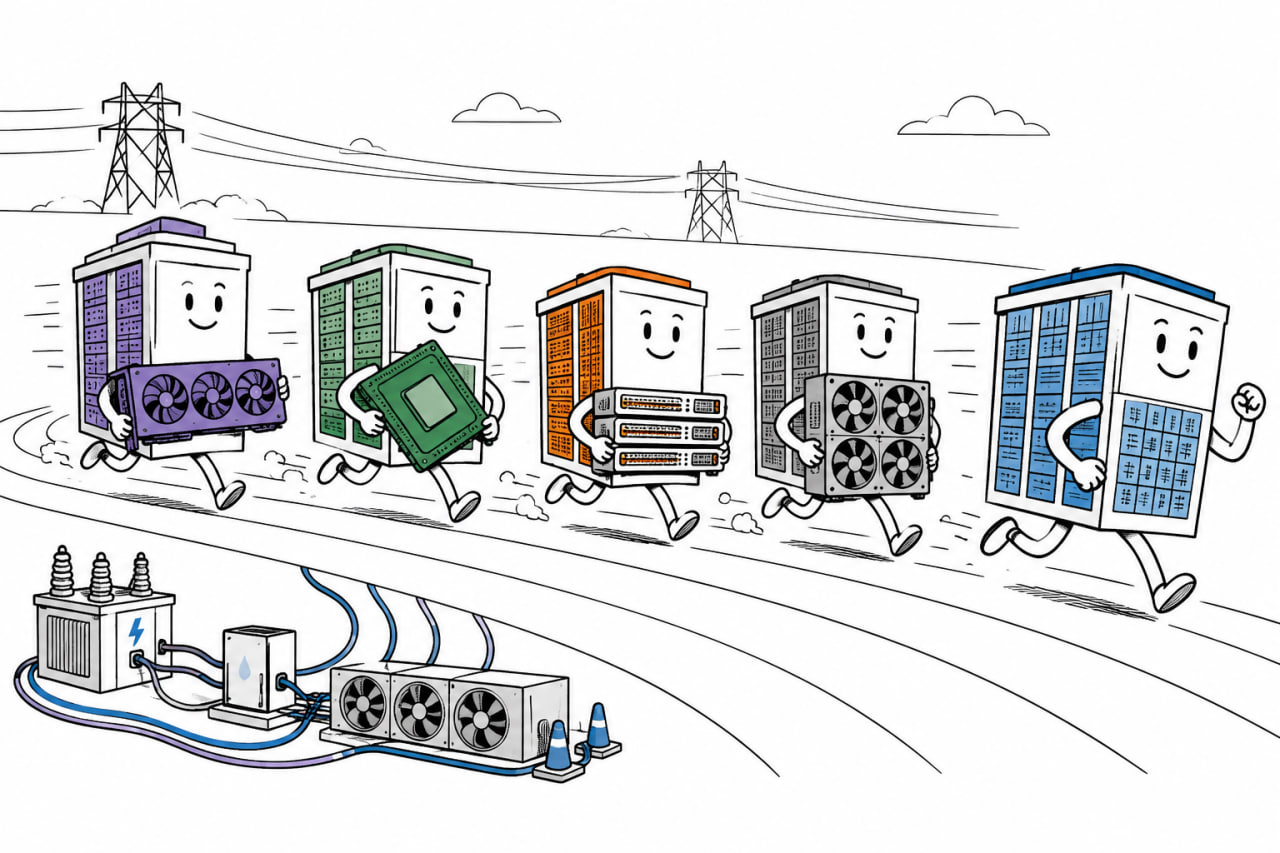
Still, the ranking reveals the infrastructure race beneath the product race. On the surface, consumers see Grok, Gemini, Claude, Llama, ChatGPT and Copilot competing for attention. Underneath, Colossus, Fairwater, Pryor, New Carlisle and Prometheus are competing for chips, electricity and the ability to run hundreds of thousands of accelerators reliably.
The next frontier model will depend not only on better algorithms and more data, but also on who can secure the chips, connect the power and bring the data center online first.