Why AI Tokens May Become the Most Important Resource of the AI Era
Every major leap in productivity has reorganized the resources that power the economy. In the age of artificial intelligence, a new measurable resource is emerging: the AI token.
The steam age depended on coal. Industrial economies were built on oil and electricity. The internet era depended on data, bandwidth, and computing power. As artificial intelligence moves into everyday business, tokens are becoming a common way to measure the resources consumed by models and AI agents.
Technically, a token is simply a unit used to represent text, code, images, or other information inside a model. Economically, it is becoming a bridge connecting Electricity, AI Factories, GPU compute, model inference, and business outcomes.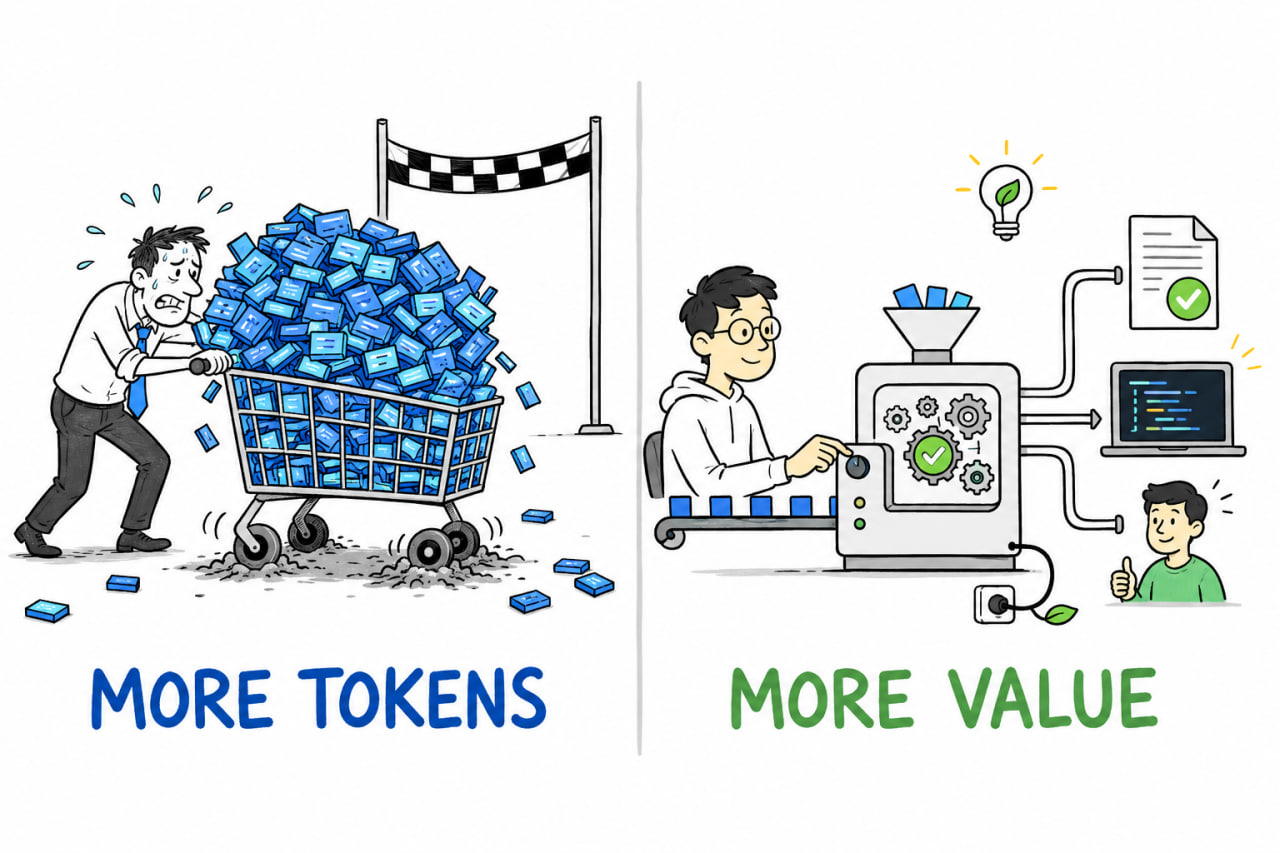
From a technical concept to an economic resource
A few years ago, conversations about AI centered on parameter counts, training clusters, and benchmark rankings. As generative AI and AI agents enter real commercial workflows, companies are asking a more practical question: how many tokens does it take to complete one useful task?
Whether a business uses a commercial model API or deploys an open-source model, token consumption is frequently part of its cost calculation. A simple response may use relatively few tokens. A complicated agent task may require planning, retrieval, tool calls, long context, self-correction, and repeated inference. Those operations ultimately become GPU time, electricity demand, and an operating expense.
The token is therefore moving beyond the developer console. It is becoming one of the basic units of the AI economy.
What is an AI token?
People communicate with words, sentences, and paragraphs. A model first breaks that information into smaller units it can process. This process is known as tokenization.
A token may be a whole word, part of a word, punctuation, a number, or a piece of code. Different models use different tokenization methods, so the same sentence may not produce exactly the same token count across systems.
Tokens can be compared with bytes in computing, data usage in telecommunications, or CPU time in cloud services. They make an abstract inference process recordable, comparable, billable, and optimizable.
How tokens work
The user’s text, code, or other information is divided into units the model can process.
It generates an answer step by step, repeatedly calculating what is most likely to come next.
The generated sequence is assembled into text, code, structured data, or another result.
This process appears to happen entirely in software, but it depends on physical GPU servers, data centers, electricity, cooling systems, and networks. No token is produced without infrastructure.
The industrial chain behind every token
Electricity powers the data center. AI factories use that energy to operate GPUs and other systems. Models use the available compute to perform inference and generate tokens. Applications and AI agents then use those tokens to complete customer-service, programming, research, design, and operations tasks.
From this perspective, tokens are a measurable intermediate output of an AI factory—but they are not the final product. Businesses need completed tasks, lower operating costs, better decisions, and revenue.
Token effectiveness matters more than token volume
Global token usage is likely to keep growing as model APIs and AI agents spread through the economy. China offers one useful case study: its model ecosystem and expanding enterprise adoption are increasing demand for inference services. In the United States, commercial APIs and open models are producing the same basic trend across software development, customer service, research, sales, and office automation.
More token consumption, however, does not automatically mean greater economic productivity. A system may consume large amounts of context, repeat failed tool calls, choose an unnecessarily expensive model, or generate content that a person must redo.
The metrics that matter
- tokens consumed per successful task;
- useful work completed per million tokens;
- revenue or savings generated by token spending;
- gross margin per AI agent task;
- first-pass completion and human takeover rates;
- useful AI tasks completed per kilowatt-hour.
It is to create the most useful value from each token.
Better models do not guarantee lower token consumption
More capable models can often solve a task in fewer steps, reduce mistakes, and avoid wasteful retries. Yet improvements in capability also encourage users to assign more complex work to AI.
A workflow that once generated a short paragraph may now search external sources, analyze files, call software tools, draft a report, and evaluate its own answer. Efficiency per inference can improve while total token demand continues to rise.
This resembles the history of computing: chips became more efficient, but society’s total demand for computation grew even faster.
Will tokens become the most important resource?
Tokens may become one of the AI era’s most important digital resources, but they cannot exist independently. Their supply depends on physical and technical conditions:
- abundant and reasonably priced electricity;
- sufficient GPU capacity inside AI factories;
- efficient models and inference software;
- reliable networking, cooling, and data-center infrastructure;
- applications capable of converting tokens into useful outcomes.
The next competitive race will not be only about models or chips. It will be a competition across the entire AI production chain. Organizations with lower-cost Electricity, highly utilized AI Factories, strong models, and superior Token Efficiency will have a durable advantage in the AI Token Economy.
From token maximization to value maximization
Businesses should not treat rising token usage as success by itself. The better objective is to eliminate unnecessary consumption while protecting output quality.
That requires intelligent model routing, compact context, fewer retries, effective caching, and models matched to the difficulty of each task. Simple work does not always need the largest model. Complex work should not be forced onto an underpowered model merely to reduce the advertised token price, because repeated failure can cost more.
The best system balances cost, quality, speed, reliability, and the business value of the completed task.
The bottom line
Tokens give the AI industry a relatively consistent unit for measuring, billing, and optimizing model inference. They connect language and software to GPUs, data centers, electricity, service pricing, and operating margins.
But a token is not intelligence and it is not the final form of value. It is an intermediate resource in a much larger industrial system.