What Does the Token Boom Really Mean—and Where Is the AI Token Economy Going?
China’s rapidly expanding discussion of tokens offers a useful window into a global shift: AI is moving from model demonstrations to an economy in which intelligence must be measured, priced, delivered, and optimized.
Token economics, token exports, token packages—the word is appearing everywhere in discussions about artificial intelligence. Yet the token began as a largely technical concept: a basic unit that a large language model uses to process text, code, images, and other information.
Why has this technical unit entered business and investment conversations? Could it become a standard for measuring AI services? And how does it connect to electricity, AI factories, infrastructure costs, and corporate margins?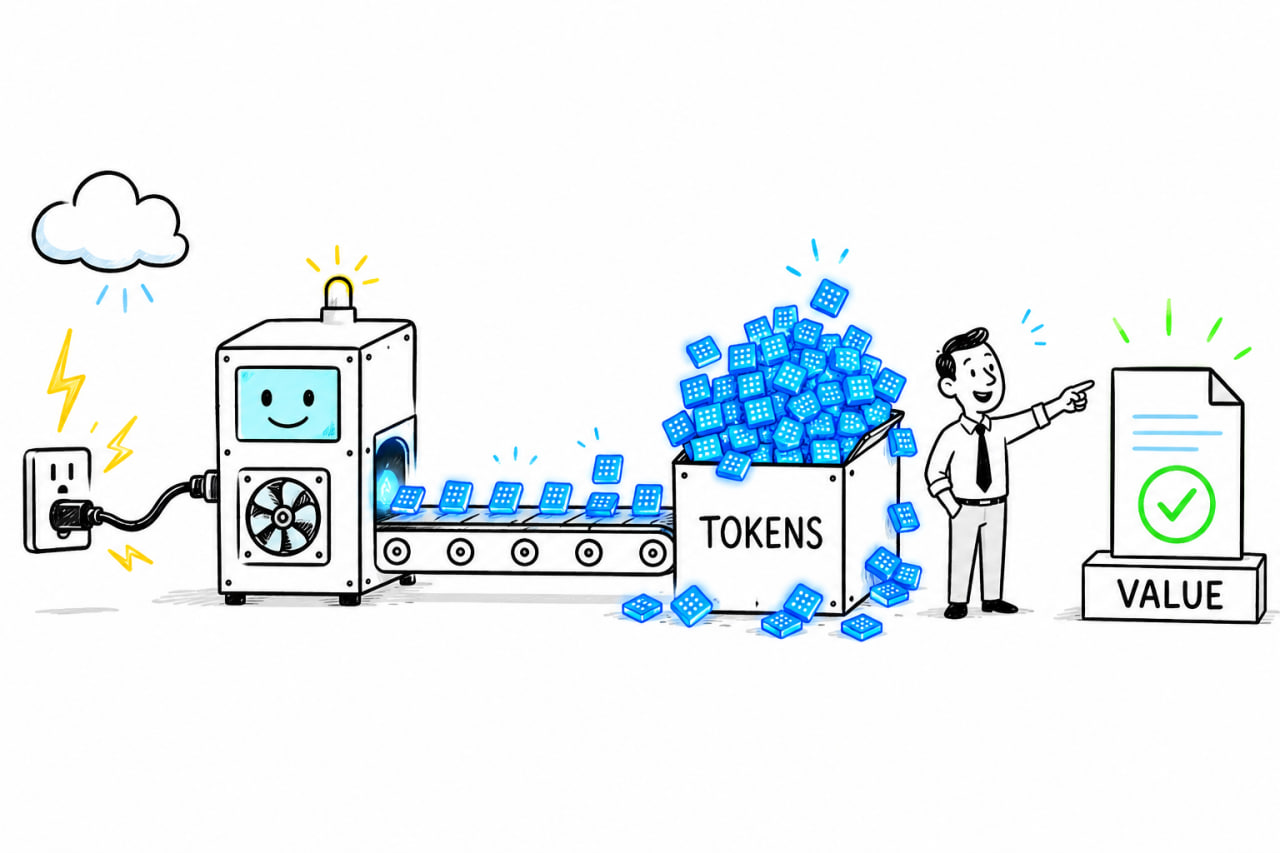
What exactly is a token?
In artificial intelligence, a token is one of the basic units a model uses to process information. It may be a complete word, part of a word, a punctuation mark, or a piece of code.
When a user sends a sentence to a language model, the system does not read it exactly as a person would. It first divides the input into tokens, performs calculations across those units, and predicts what should come next.
A token is therefore not language itself. It is language translated into a machine-readable and billable form. In that sense, tokens resemble bytes in computing, data allowances in telecommunications, or CPU time and storage in cloud computing: they turn an abstract process into something that can be recorded, priced, and optimized.
Tokens are becoming a unit of AI service consumption
Major U.S. model providers commonly charge developers according to the number of input and output tokens used. The final cost of an API workflow may depend on several factors:
- which model is selected;
- how many input and output tokens are processed;
- whether long context, reasoning, search, or caching is used;
- how many model calls are required to finish one task;
- whether tools or multiple AI agents participate in the workflow.
This makes the token an important bridge between model capability and commercial cost. But a token is not the same as intelligence, and it is certainly not the same as business value.
It is to create more useful work per token.
If one AI agent requires three times as many tokens as a competitor to complete the same customer-service, coding, or research task, its lower price per token may not produce a lower total cost. The real economic metric is token efficiency: how effectively a system converts model calls into successful outcomes.
China’s token boom offers a window into commercialization
In China, the token has begun moving beyond model developers and into conversations about cloud services, data centers, enterprise procurement, and AI infrastructure. Some providers have introduced token packages, bulk purchasing, and usage-based services designed to sell inference capacity in a form that resembles cloud storage or network bandwidth.
Market estimates vary because organizations use different definitions and measurement methods. The broader direction, however, is clear: as generative AI adoption expands, businesses increasingly want a practical way to track model usage and inference expense.
During the first phase of the AI race, companies focused on model size, benchmark performance, and technical prestige. Commercial users now ask different questions:
- How many tokens does one useful task require?
- How much productive work can one million tokens deliver?
- Can token spending be converted into revenue or measurable savings?
- How much GPU capacity and electricity does inference consume?
- Does the AI system actually reduce labor and operating costs?
China’s experiments with token commercialization are worth watching in the United States. They should not, however, be copied mechanically. The two markets have different cloud structures, energy systems, compliance requirements, procurement processes, and enterprise software ecosystems.
The U.S. market is mature—but faces the same value problem
The United States has a mature ecosystem of model APIs, hyperscale cloud platforms, AI infrastructure, and enterprise software. OpenAI, Anthropic, Google, and other providers have made token-based API billing familiar to developers. At the same time, AI agents are moving into customer support, software development, research, sales, and internal operations.
Token usage is therefore becoming part of the operating cost of a business, not merely a line on a developer’s test account. Yet many organizations can see how many tokens they consume without knowing whether those tokens create sufficient value.
A customer-support agent, for example, may make many model calls, load a large conversation history, perform repeated retrieval operations, and still hand the case to a person. Technically, it ran an AI workflow. Economically, a substantial amount of tokens, GPU time, and electricity failed to become an independently completed task.
Metrics that reveal actual AI efficiency
| Metric | What it reveals |
|---|---|
| Tokens per successful task | Whether the workflow converts inference into completed work |
| Revenue per million tokens | How model consumption connects to commercial output |
| Gross margin per agent task | Whether an AI service can scale profitably |
| First-pass completion rate | How often the system succeeds without costly retries |
| Human takeover rate | How much work still returns to employees |
| Useful tasks per kWh | How efficiently electricity becomes usable intelligence |
Behind every token is physical infrastructure
A token appears to be a software unit, but every generated token depends on physical resources. A typical AI value chain looks like this:
Larger models, longer contexts, and more complicated reasoning processes generally require more computation and electricity. Token pricing is therefore influenced by much more than a model provider’s pricing policy. It reflects chips, data-center construction, power availability, cooling, networking, and infrastructure utilization.
If an AI factory is a facility that produces intelligence, tokens are one measurable intermediate output. The completed AI task—not the token itself—is the final product.
The strongest AI companies may not be those that generate the most tokens. They may be the companies that turn each unit of electricity and compute into the greatest number of reliable, high-value outcomes.
Can tokens become a universal measure of value?
Tokens will likely remain an important unit for metering and settling AI consumption, but they cannot measure all forms of AI value by themselves. One token does not have the same value across different models, tasks, and quality requirements.
Writing a routine marketing email and completing a complex scientific analysis may consume a similar number of tokens while producing dramatically different economic value.
The AI Token Economy may therefore develop as a three-layer system:
- Infrastructure layer: electricity, GPU time, networking, cooling, and data-center costs.
- Inference layer: model calls, context processing, and input-output token consumption.
- Application layer: completed tasks, business outcomes, or value-based pricing.
Token-based billing will remain useful for standardized work such as classification, summarization, data extraction, and routine customer support. More complex AI agent services may gradually move toward outcome-based pricing—for example, charging for a resolved support case, a completed coding task, or a qualified sales opportunity.
Where does the AI Token Economy go next?
Its development will depend on three conditions.
1. Standardization
Companies need consistent ways to compare models, providers, and agent workflows. Comparing only the advertised price per million tokens can hide expensive retries, oversized contexts, poor routing, and low task-completion rates.
2. Transparency
Customers need to understand how many tokens a task consumed, which models were called, why additional calls occurred, and how those choices affected the final bill.
3. Outcome measurement
Token usage becomes an economic metric only when a company can connect it to a result: revenue, cost reduction, faster completion, improved quality, or a successfully automated task.
The bottom line
The token solved an important problem. It made an abstract model-inference process measurable, billable, and optimizable. But it remains an intermediate unit in the value chain, not the final objective.
For the U.S. market, China’s emerging token packages, bulk purchases, and commercialization of inference resources provide an instructive case study. The more important task is to build a complete economic model that connects electricity, computing infrastructure, token consumption, and successful outcomes.