NVIDIA Is Going All In on HBM: Inside Its $500 Billion AI Plan With SK Group
The sweeping partnership combines gigawatt-scale AI factories, NVIDIA’s Vera Rubin platform, and SK hynix’s next-generation high-bandwidth memory.
This time, NVIDIA really is going all in.
On July 24, NVIDIA and South Korea’s SK Group announced plans to advance an AI partnership representing more than $500 billion in potential commercial activity.
That figure sounds almost unbelievable. But it is not a purchase order being paid on day one, and it does not mean NVIDIA is spending $500 billion simply to buy memory. It describes a long-term, comprehensive partnership spanning AI data centers, AI cloud infrastructure, and next-generation memory.
The plan has two major pieces
01. A 2 GW-class AI cloud and AI factories.
SK Telecom plans to build a gigawatt-scale AI cloud in South Korea using NVIDIA’s DSX platform, targeting roughly 2 GW, with the first AI factory expected to begin operating in 2027.
02. Joint development of next-generation AI memory.
SK hynix will deepen its long-term relationship with NVIDIA to supply and advance future memory technologies, including HBM.
The real goal is not merely to build one enormous data center. It is to connect the entire AI infrastructure stack—from power, buildings, and GPUs to HBM, networking, software, and operations.
01. What Does a 2 GW AI Factory Actually Mean?
Under the public plan, SK Telecom will use NVIDIA’s Vera Rubin platform and DSX AI factory architecture to build infrastructure for sovereign AI, enterprise AI, robotics, smart manufacturing, and AI agents.
Vera Rubin is NVIDIA’s next-generation AI platform following Blackwell. A Vera Rubin NVL72 rack combines 72 Rubin GPUs and 36 Vera CPUs, then connects them through NVLink and high-speed networking to form much larger AI clusters.
DSX is not a GPU or a single server. It is NVIDIA’s playbook for designing, building, and operating an entire AI factory.
Traditional data centers often source processors, servers, networks, storage, power equipment, and cooling systems separately, then rely on multiple vendors to integrate everything. DSX attempts to co-design compute, networking, storage, software, power, cooling, and operations around one central metric: how many AI tokens a facility can produce per megawatt.
That is why NVIDIA keeps using the term “AI factory.” The data center of the future will not merely store and transmit information. It will continuously consume electricity and data to produce tokens, predictions, and AI services.
The scale
2 GW = 2 billion watts of power capacity
That places the project in the same broad class as the multi-gigawatt AI campuses being developed by major U.S. technology companies.
For comparison, Meta originally announced more than 2 GW of compute capacity for its Richland Parish AI data center in Louisiana, then expanded the plan to 5 GW in 2026. SpaceXAI is also constructing a 1.2 GW permanent power plant for its Colossus facilities near the Tennessee-Mississippi border.
Even by U.S. standards, SK Telecom’s proposed 2 GW buildout belongs in the same conversation as projects from Meta and xAI. That does not mean all 2 GW will come online in 2027, however. The first AI factory is expected to begin operating that year, while later capacity will still depend on power, land, equipment supply, permitting, and customer demand.
SK Telecom is therefore aiming at more than providing cloud services to Korean companies. By combining its telecom network and data center experience with SK Group’s semiconductor capabilities, it wants to position South Korea as an AI infrastructure hub for the broader Asian market.
02. What NVIDIA Really Wants Is HBM
If you look only at the data centers, you may miss the other half of the deal. NVIDIA does not just need more buildings and electricity. It also needs vast quantities of high-bandwidth memory, better known as HBM.
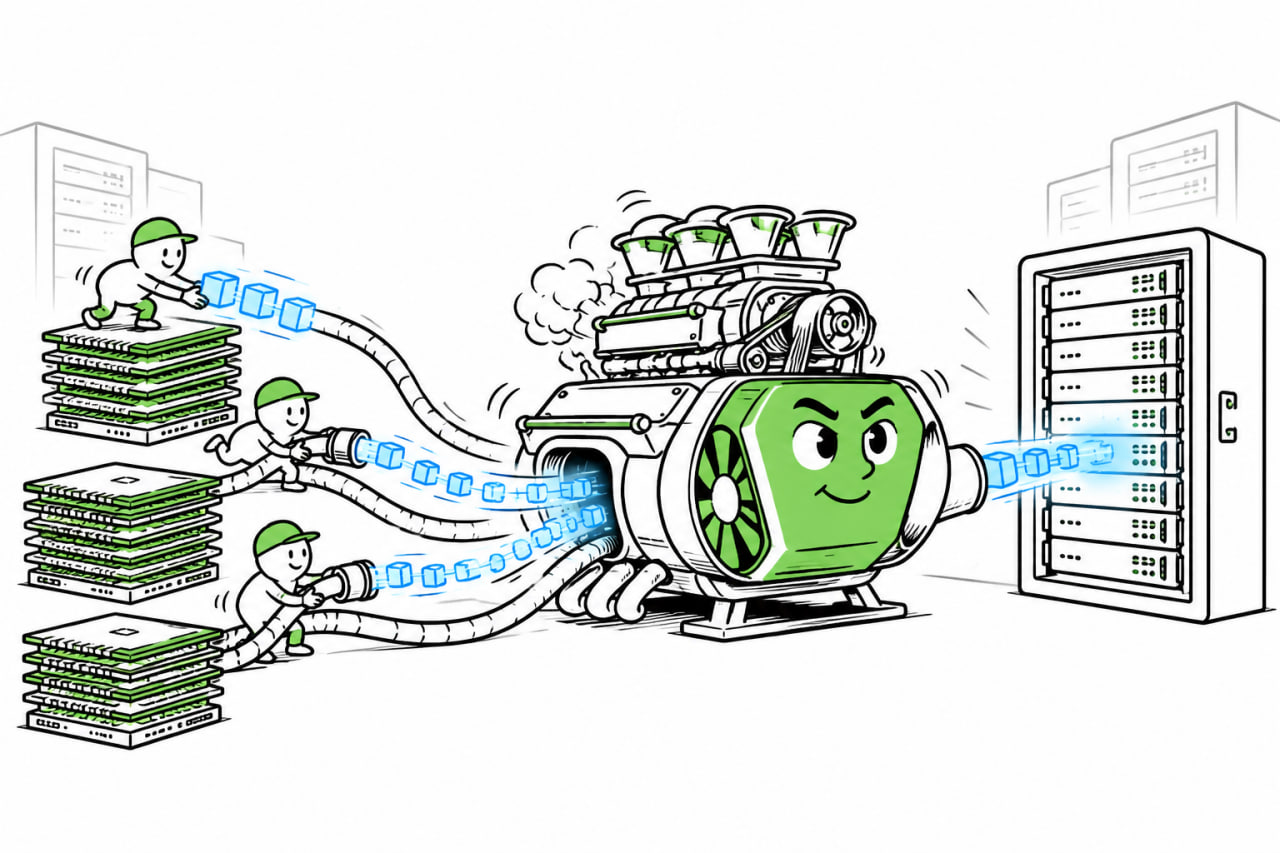
In modern AI systems, GPUs perform the calculations while HBM moves model parameters and data into the processors at extremely high speed. Think of the GPU as a high-performance engine and HBM as the system that keeps feeding it fuel. No matter how powerful the engine is, it will sit idle if data cannot arrive fast enough.
That is why HBM has gone from a relatively specialized memory product to one of the most important—and supply-constrained—components in the AI industry.
SK hynix has long supplied HBM for NVIDIA platforms and has progressed from HBM3E to HBM4. NVIDIA’s Rubin GPUs use HBM4, while future generations will demand even more capacity, bandwidth, and advanced packaging.
Why the partnership matters
For NVIDIA, the agreement is not only about securing memory capacity in advance. It is also about jointly developing the memory technologies that future AI factories will require. NVIDIA can sell enormous numbers of GPUs, but complete AI systems still cannot ship on time if HBM supply falls behind.
This part of the story has a direct U.S. connection. SK hynix is building an approximately $4 billion advanced AI chip packaging and research facility in West Lafayette, Indiana, near Purdue University. Under its latest plan, the facility is expected to begin mass-producing next-generation HBM4E products in the third quarter of 2029. Wafers will still be manufactured primarily in South Korea before being sent to the United States for packaging and testing.
So although the partnership centers on American and South Korean companies, it could directly influence chip supply, server prices, data center construction schedules, semiconductor investment, and employment in the United States.
03. Why Memory Is Becoming More Important
When people discuss AI chips, the GPU usually gets all the attention. But as model sizes, context windows, and agentic workloads expand, memory capacity and bandwidth are becoming major bottlenecks.
Models must repeatedly access enormous numbers of parameters, while inference systems need to retain increasingly large KV caches. If data movement cannot keep up, even the most expensive GPUs cannot operate at full efficiency.
In other words, the compute chip may not always be the most expensive component in an AI server—but memory can still be the component that holds the entire machine back.
Recent increases in AI server prices reinforce that point. As demand for HBM and server DRAM continues to climb, memory costs are increasingly affecting the price of complete systems based on platforms such as Vera Rubin and Grace Blackwell. The AI industry is no longer competing only for GPU production. It is also competing for HBM, advanced packaging, electricity, and cooling capacity.
Behind the enormous headline number, the NVIDIA-SK partnership is attempting to solve three problems at once:
1. Secure supplies of next-generation HBM.
2. Create gigawatt-scale deployment sites for Vera Rubin and future platforms.
3. Turn GPUs, memory, networking, power, and data centers into a repeatable AI factory model.
SK Group has its own reasons for going along. SK hynix can strengthen its leadership in HBM, while SK Telecom can reposition itself from a conventional telecom operator into an AI infrastructure company. One side provides the “memory,” another provides the buildings and networks, and NVIDIA supplies the GPUs and software.
Ultimately, the scarce asset behind this partnership is not the $500 billion headline. It is the combination of four things: electricity, GPUs, HBM, and the engineering ability to make them work together.
The next AI race may not be decided only by whose model is smarter. It may also depend on who can secure power, finish the data center, and keep tens of thousands of chips supplied with memory.