How the Token Economy Could Reshape Global Wealth
AI tokens may look like units of text, but producing them requires chips, electricity, data centers, models, and distribution. As AI becomes part of everyday work, control over those resources could influence where the next wave of wealth accumulates.
Oil, manufacturing capacity, and financial capital have long shaped the distribution of global wealth. In the AI era, advanced chips, data-center capacity, electricity, and model capabilities are forming another layer of economic power.
Every AI conversation, software-generation request, research workflow, or autonomous-agent task consumes tokens. As AI moves beyond chatbots and into business operations, finance, software development, and automation, the production, pricing, and allocation of tokens could affect which countries, companies, and individuals capture the most value.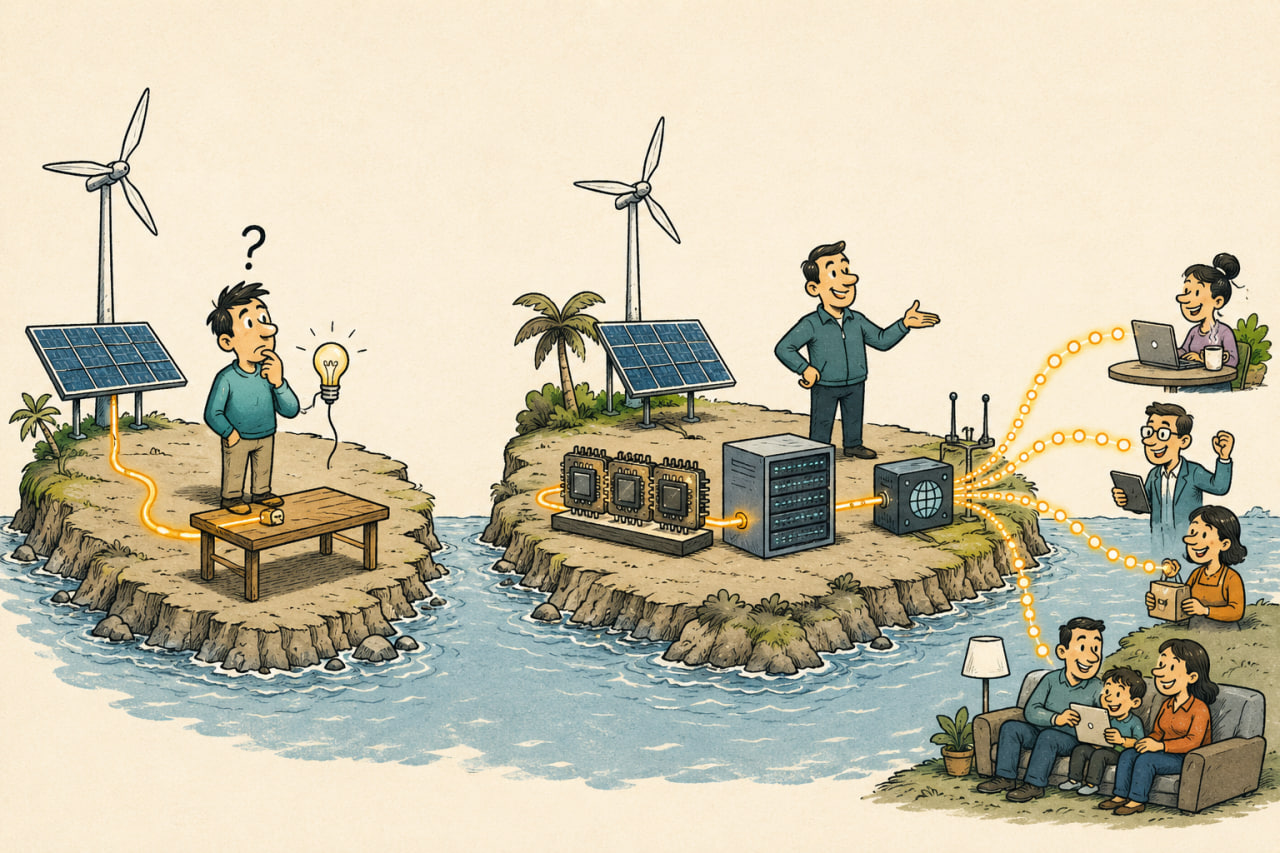
Compute and Energy Are Becoming New Barriers to Entry
More economic value may flow toward organizations that control the capacity to produce tokens at scale. Today, advanced AI compute remains concentrated among a relatively small group of chip suppliers, cloud platforms, and frontier-model developers.
GPUs, high-bandwidth memory, high-speed networking, data centers, and dependable electricity together form the physical production system behind every token.
As reasoning models and AI agents grow more capable, token consumption may continue to rise. A simple question may use relatively few tokens, while coding, deep research, and multi-agent collaboration can require long contexts, repeated inference, external tools, and verification.
That could concentrate value in several parts of the AI supply chain:
- AI accelerators and high-bandwidth memory;
- cloud computing and data centers;
- electricity generation and grid infrastructure;
- foundation models and inference platforms;
- AI applications that control customer relationships.
The United States holds important advantages in chip design, cloud computing, and frontier AI. NVIDIA, Microsoft, Amazon, Google, Meta, OpenAI, and Anthropic each control strategically important parts of the stack.
Yet the competition is not simply about who owns the most GPUs. Electricity prices, grid capacity, permitting, land, cooling conditions, fiber connectivity, and construction timelines can determine how quickly chips become usable token capacity.
A bottleneck in any one of these areas can raise the effective cost of producing useful AI output.
Cloud Providers Are Competing for Token Demand
API pricing is one of the clearest expressions of competition in the token economy. Providers set different rates for input, output, cached input, batch jobs, and service tiers.
Per-token prices have generally declined, but the cost of completing an AI task does not always fall at the same rate. Applications are becoming more complex.
A conventional chatbot might require one prompt and one answer. An AI agent may search the web, read documents, call software, execute code, inspect results, and retry after failure. Tokens can become cheaper while the number of tokens consumed per task rises.
This helps explain why cloud and model providers use lower prices, developer credits, and inexpensive models to compete for adoption. Once developers build applications, data pipelines, and operating processes around a platform, switching creates new costs.
Low pricing may reflect superior utilization and inference engineering—or it may reflect a temporary subsidy. A durable cost advantage must be evaluated over time.
Low-Cost Energy Can Become an Exportable Digital Capability
The token economy may create opportunities for regions with abundant, reliable energy. Traditional exports require moving raw materials or finished goods. Tokens can be delivered through global networks almost instantly.
When local electricity powers model inference, energy can effectively be sold in the form of AI APIs, cloud services, and automated software.
In the United States, states with access to natural gas, nuclear, hydroelectric, wind, or solar power may attract more data-center investment. But power prices alone do not determine success. Transmission, fiber connectivity, water availability, skilled labor, permitting, and community acceptance all matter.
A region can have cheap electricity and still struggle to produce competitively priced tokens if it lacks the infrastructure needed to turn power into reliable computation.
China as a Case Study: Connecting Energy, Models, and Cloud Services
China offers a useful international comparison. Parts of western and northern China have substantial wind, solar, hydroelectric, and land resources, while coastal regions contain more internet companies, developers, and AI demand.
Programs such as China’s “Eastern Data, Western Computing” initiative seek to move suitable computing workloads toward regions with more favorable energy and land conditions, then deliver the resulting services over national networks.
As Chinese models improve and usage expands, Chinese AI APIs are also reaching overseas developers. Some industry reports indicate a rising share of model usage, although estimates vary significantly by platform coverage and methodology. Such numbers are better treated as evidence of direction than as a universally comparable market share.
The case illustrates that the token economy is not determined only by which company has the most capable model. Competitiveness can also come from combining:
- relatively low-cost energy;
- large-scale data centers;
- access to suitable AI hardware;
- efficient inference models;
- reliable cloud services;
- international developer and customer channels.
In that sense, exporting tokens is really the export of a digital service created jointly by energy, infrastructure, and software.
How Could the Token Economy Shift Wealth Between Countries?
The token economy could create new advantages while widening existing gaps.
First, countries and companies that control advanced chips and strategic intellectual property can capture revenue from the expansion of AI infrastructure.
Second, regions with affordable energy, stable grids, and suitable data-center conditions can convert power into globally marketable computing services.
Third, platforms that control models, developer tools, and application distribution may earn high margins even when they do not own every layer of the underlying infrastructure.
Regions facing high power prices, limited chip access, difficult construction conditions, and weak developer ecosystems may need to import more AI services. Part of their digital-economy spending could flow toward compute and model suppliers abroad.
This structure is not fixed. Open models, efficient small models, specialized chips, and local deployment can reduce barriers. A country does not necessarily need to build the world’s most powerful general-purpose model to compete; it may create value through local languages, proprietary industry data, vertical applications, or efficient inference.
Token Spending Is Moving From Businesses to Individuals
As AI agents become more common, token costs will increasingly affect individual users. Consumers currently encounter AI through flat monthly subscriptions and may rarely consider how much a conversation consumes.
That could change as agents perform persistent research, coding, content production, financial analysis, and personal-assistant tasks. The same goal can carry dramatically different costs depending on the model, context length, tools, and execution strategy.
- Simple editing may need only a small model.
- Deep research may require search and repeated verification.
- Coding agents may repeatedly read files, run tests, and repair errors.
- Multi-agent systems may ask several models to examine one issue.
- Poorly configured automation may retry in the background and consume credits.
Managing AI spending may eventually feel as routine as managing cloud storage, mobile data, and software subscriptions.
Five Practical Ways to Control Token Costs
1. Match the model to the task
Routine formatting, translation, and summarization may not require the most expensive frontier model. Reserve advanced models for difficult reasoning, code review, and higher-stakes work.
2. Remove unnecessary context
Longer context requires more processing. Remove irrelevant chat history, compress background information, and upload only necessary files. Persistent agents also need memory-management rules and context limits.
3. Use caching and batch processing
Applications that repeatedly send the same system prompt, document, or reference material may reduce redundant work with caching. Non-urgent workloads may also benefit from discounted batch APIs.
4. Give agents budgets and stopping conditions
Set limits on calls, runtime, tokens, and retries. Require an agent to stop when it reaches a sufficient answer or can no longer improve the result. This can matter more than selecting the lowest advertised token price.
5. Evaluate “free tokens” carefully
Free credits can lower experimentation costs, but users should understand usage limits, privacy policies, and future pricing. Free tokens are an entry point—not proof of sustainable long-term economics.
New Opportunity, New Inequality
The token economy can create new sources of wealth. Energy can become computation, developers can sell AI applications worldwide, and individuals can use agents to increase productivity.
It can also create a new divide. Organizations with advanced chips, affordable power, data centers, model expertise, and capital can produce intelligence at lower cost. Those without these resources may pay more for the same capability.
Tomorrow’s digital divide may be defined by questions such as:
- Can people and businesses access affordable AI compute?
- Can they use high-quality models?
- Do they have sufficient token budgets?
- Can they convert AI output into income and productivity?
Note: Market-share estimates, infrastructure costs, energy prices, and API economics vary by source, geography, provider, workload, and methodology. Examples in this article illustrate structural trends rather than guaranteed outcomes.