 AI Training & Data
From 300 Billion to 15 Trillion Tokens: How Data Scale Shapes—and Sometimes Appears to Unlock—AI Capabilities
Why modern language models consume trillions of tokens, what scaling laws really say, and why more data does not automatically mean more intelligence.
The first time people use a powerful language model, the experience can feel almost magical.
It can draft an essay, explain quantum mechanics, analyze business data and hold a natural conversation. That leads to an obvious question: why does it seem to “know” so much? Did it really read the entire internet?
It certainly processed an enormous amount of material. But the key is not simply how many web pages it saw. It is how that material was converted into tokens—and how the model learned statistical structures from those tokens.
1. A Language Model Is Predicting the Next Token
Many people imagine training as storing books, news, code and reference materials inside a giant database. That is not quite what happens.
The core pretraining task is remarkably simple: given the preceding content, predict the next token.
The capital of France is ___
The model should assign a high probability to “Paris.” It performs variations of this exercise across trillions of examples. When a prediction is wrong, training adjusts internal parameters; when it is closer to the target, the relevant patterns are reinforced.
After enough repetitions, the model learns grammar, facts, writing styles, code structures and relationships among concepts. It is not literally memorizing the internet page by page. It is compressing patterns that recur across the data.
2. What Is a Token?
A token is a basic unit processed by a model, but it is not always a complete word. In English, one token averages roughly four characters or about 0.75 words. A 300-word article might therefore become around 400 tokens, although punctuation, numbers, vocabulary and the tokenizer all affect the result.
Other languages behave differently. Chinese is a useful example: one character may correspond to one or more tokens, while some frequent character combinations may be grouped together. Two sentences with the same meaning in English and Chinese can produce very different token counts.
3. From 300 Billion to More Than 15 Trillion Tokens
| Model | Parameters | Training Tokens |
|---|---|---|
| GPT-3 | 175B | ~300B |
| Chinchilla | 70B | 1.3T |
| Llama 3 | 8B / 70B | 15T+ |
| Llama 3.1 405B | 405B | 15T+ |
The difference between 300 billion and 15 trillion is roughly fiftyfold. More importantly, researchers learned that increasing parameter count alone is not always efficient. A very large model trained on too little data may simply be undertrained.
DeepMind’s Chinchilla illustrated the point. Its 70-billion-parameter model was trained on 1.3 trillion tokens and, under a comparable compute budget, outperformed the 280-billion-parameter Gopher across many evaluations. Model quality depends not only on size, but also on whether parameters, data and compute are balanced.
4. Scaling Laws: Why More Scale Usually Helps
Scaling laws describe relatively predictable relationships among model size, training data, compute and training loss. Within a useful range, increasing these resources together tends to reduce loss and improve performance.
More data exposes the model to more linguistic and conceptual patterns.
More parameters provide capacity to represent complex relationships.
More compute allows the model to absorb those patterns more thoroughly.
But none is sufficient alone. Data without adequate capacity and compute cannot be fully absorbed. Parameters without enough data remain undertrained. Compute spent on duplicated or low-quality material may simply waste GPU time.
Scaling laws are therefore not a license to pile up data blindly. They are tools for finding a better balance among parameter count, token count and training budget.
5. Does Scale Create “Emergent Abilities”?
As models became larger and better trained, they began demonstrating abilities that were much less visible in smaller systems: learning tasks from a few examples, multi-step reasoning, writing code, translating across languages and using tools from natural-language instructions.
These behaviors are often called emergent abilities: capabilities that appear after a system crosses some scale or performance threshold, even though engineers did not explicitly program each task.
Other research suggests that certain capabilities do improve sharply once pretraining loss falls below a particular level. The cautious conclusion is that scaling data, parameters and compute usually improves capability—but training scale alone cannot reliably predict exactly when a new ability will appear.
6. Is More Data Always Better?
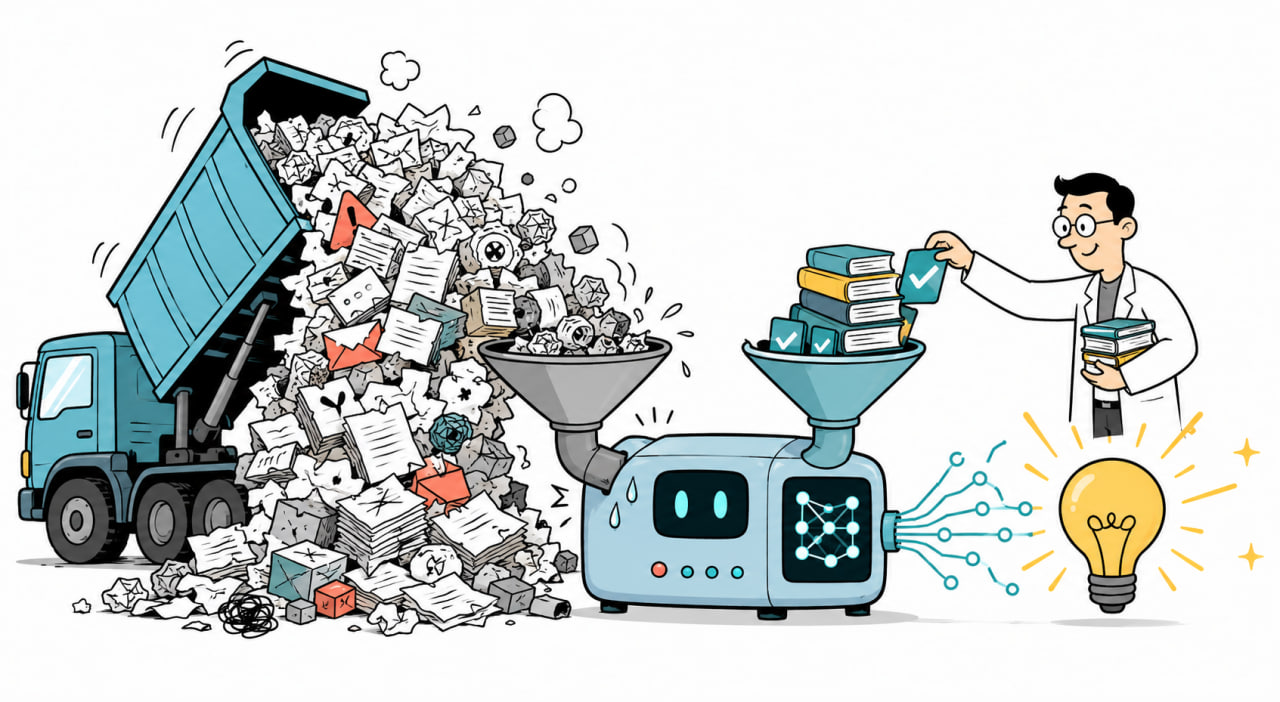
No. The real question is not who has the most data, but who has the most useful, diverse and well-curated data for the training objective.
Low-quality corpora can contain:
• Duplicate pages and SEO spam
• Incorrect or outdated claims
• Unverified machine-generated text
• Private, copyrighted or unsafe material
• Geographic, linguistic and ideological imbalances
If these sources dominate, a model may repeat errors, amplify bias or memorize near-duplicates without improving generalization. That is why major AI labs invest heavily in deduplication, quality scoring, classification, privacy filters and safety review.
7. Why Non-English Data Still Matters
U.S. model developers draw heavily from the English-language internet, but the global market is not English-only.
China is one useful example. Chinese legal, medical, financial, manufacturing and local-service information often has no high-quality English equivalent. A model trained primarily on English may perform well in general tasks while missing Chinese policy context, local industry knowledge and natural patterns of expression.
The same challenge applies to Spanish, Arabic, Japanese, Korean and many lower-resource languages. Multilingual data is not only for translation; it exposes models to knowledge, cultures and problem formulations that may not exist in English. For American AI companies serving global customers, that has direct commercial value.
8. Is the Internet Running Out of Training Data?
As training corpora reach trillions of tokens, the industry increasingly worries about a shortage of high-quality public data. The problem is not that the internet lacks text. It is that legally usable, sufficiently accurate and non-duplicative material is limited.
AI labs are pursuing several alternatives:
Synthetic data: stronger models generate questions, reasoning traces, code and examples that are verified before reuse.
Multimodal data: models learn from images, audio, video, sensors and real-world interactions.
Retrieval and tools: models access databases, search systems and software instead of memorizing everything in their parameters.
Higher data efficiency: improved training methods extract more capability from the same high-quality material.
Synthetic data is not a free, infinite resource. Repeatedly training on unfiltered model output can compound errors and reduce diversity. It must be combined with validation, real-world data and strong quality controls.
9. The Next Race Is About Effectiveness, Not Just Volume
For several years, the defining word in AI was “more”: more parameters, more tokens and more GPUs. The next phase may be defined by “more effective.”
The winners may be those that secure higher-quality and more diverse data, use synthetic data and human feedback responsibly, achieve more capability with less compute, connect models to tools and current information, and build sustainable approaches to copyright, privacy and compliance.
From 300 billion to 15 trillion tokens, the real change is not merely numerical. The ceiling of the next AI generation may depend less on who has the most data—and more on who combines data, algorithms, compute and feedback most effectively.