Cross-Border E-Commerce Meets the AI Token Economy: A New Growth Engine for Global Commerce
As advertising returns weaken and global operations become more complex, AI tokens and persistent agents could give cross-border merchants a more measurable path to productivity and growth.
Traditional e-commerce is entering a more difficult stage. Customer-acquisition costs are rising, advertising returns are declining, and user retention is becoming harder. For U.S. merchants selling internationally, multilingual service, localization, payments, logistics, returns, compliance, and shifting consumer preferences add another layer of complexity.
The old strategy of simply buying more traffic is losing efficiency. The AI Token Economy offers another possibility: growth based on measurable intelligence, automated services, and more productive use of computing resources.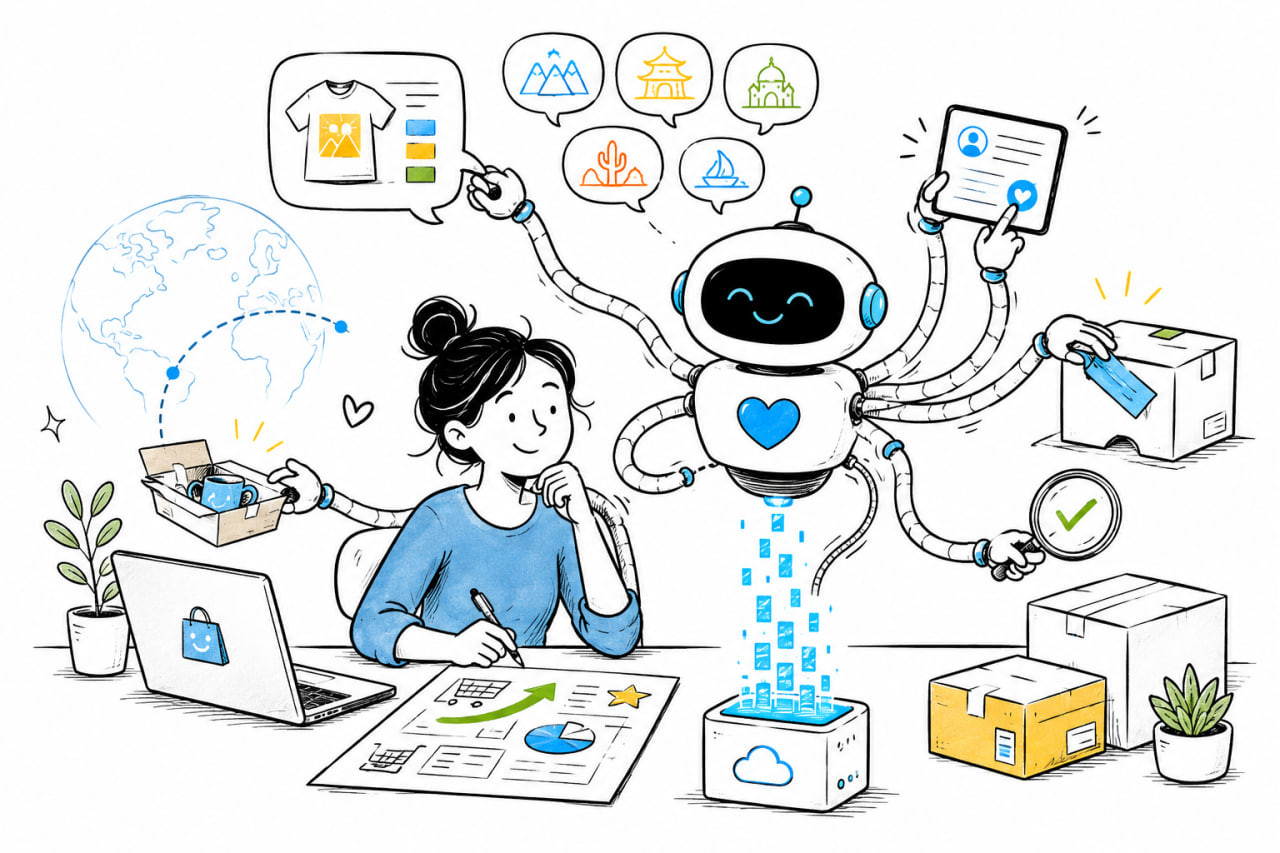
What is the AI Token Economy?
Tokens are basic units that AI models use to process text, code, images, customer requests, product descriptions, and agent actions. This allows AI activity to be recorded, priced, compared, and optimized.
Just as bytes made digital information measurable and cloud computing made processing power rentable, tokens make model inference and AI services easier to meter.
Cross-border merchants can already use AI to localize listings, create regional campaigns, answer multilingual questions, analyze reviews, recommend products, forecast demand, monitor competitors, and automate recurring workflows. Every activity consumes tokens. The economic question is whether that consumption creates enough useful value.
From occasional AI use to persistent agents
A conventional chatbot is often used in short bursts: a person asks a question, the model replies, and the interaction ends. A persistent AI agent may continuously monitor store activity, respond to customers, update product information, analyze campaigns, coordinate tools, and recommend operational changes.
A practical cross-border workflow
- Detect a surge in complaints.
- Classify them by language and product.
- Identify a translation, sizing, or logistics problem.
- Prepare an updated product description and localized responses.
- Notify the operations team and monitor whether returns decline.
Such workflows may require repeated model calls, retrieval, tool use, long context, and verification. Token consumption therefore becomes part of everyday operations rather than an occasional software expense.
The goal is not to make agents consume more tokens. It is to use the fewest necessary tokens to complete reliable, valuable tasks.
Tokens connect commerce to physical infrastructure
Tokens exist inside software, but they depend on physical GPU servers, electricity, data centers, cooling, networking, and inference systems.
Electricity powers the data center. AI factories run the models. Inference generates tokens. Agents use those tokens to complete commercial work. Tokens are therefore a measurable digital output created from physical energy and computing infrastructure.
If power becomes more expensive, GPU utilization declines, or an agent wastes tokens through repeated calls, the cost of the final service rises. Token economics is inseparable from Electricity and AI Factory efficiency.
A token is worth what it accomplishes
Not every token creates equal value. Repetitive, low-quality advertising copy may add little. Identifying a logistics problem, preventing fraud, or reducing returns may be far more valuable.
| Metric | Business question |
|---|---|
| Tokens per completed task | Is the workflow efficient? |
| Revenue per million tokens | Does AI spending produce income? |
| Resolution and takeover rates | Can the agent finish without human rescue? |
| Return-rate reduction | Does localization improve customer outcomes? |
| Useful tasks per kWh | How effectively does power become useful intelligence? |
A cheap model that repeatedly fails can cost more than a capable model that succeeds on the first attempt. An oversized model also wastes money when a smaller model can perform the routine work. Effective systems route each task to the appropriate model.
Four ways token economics could reshape global commerce
1. AI services become measurable
Companies can track inference consumption by function, country, product, or customer group instead of paying for a vague promise of AI capability.
2. Intelligence becomes available on demand
Smaller merchants can access localization, research, service, and marketing capabilities that once required large international teams.
3. Pricing moves from seats toward outcomes
Agent services may be priced by tokens, resolved requests, localized listings, reviewed orders, prevented returns, or influenced revenue. Token billing could become an intermediate step between software subscriptions and outcome-based pricing.
4. Infrastructure efficiency becomes a commercial advantage
Companies with efficient AI factories, smart routing, and lower inference costs may provide better agent services while maintaining healthier margins.
From oil to electricity—and from electricity to tokens
Industrial expansion was closely associated with oil. Electrification transformed factories, transportation, and cities. The internet made information globally transferable. AI may create another transition: electricity powers compute, compute produces inference, inference generates tokens, and tokens enable agents to perform economic work.
Tokens will not replace electricity. They may become one of the clearest ways to measure how electricity and computing infrastructure are converted into machine intelligence.
The real opportunity is computational freedom
A small merchant may operate across several markets with AI-assisted localization, service, research, and workflow automation. A brand may test a new country before building a large regional team. Employees can spend less time coordinating repetitive work and more time on strategy, relationships, and creative decisions.
This is computational freedom: access to useful intelligence as an on-demand service. It still requires human oversight, secure data, privacy controls, transparent token usage, measurable outcomes, and protection against automated errors.
The bottom line
The AI Token Economy may become an important new layer of cross-border e-commerce. Tokens provide a measurable connection between electricity, AI factories, inference, agent activity, and commercial outcomes.
But the token itself is not the final value. The value lies in serving customers, entering markets, reducing returns, improving localization, saving employee time, and generating sustainable revenue.