China Just Launched “Token Loans.” Could AI Usage Become Credit in America?
China is testing bank loans that use verified AI activity, compute contracts, and receivables as credit signals. The United States already finances GPUs and data centers—but has yet to develop a standardized credit product for smaller AI companies based on model usage.
In the United States, AI financing is largely organized around GPUs, data centers, power agreements, and long-term cloud contracts.
China is now testing something closer to the application layer: a credit product linked to the operating activity of AI companies.
In August 2026, Guangzhou’s Haizhu District introduced specialized financial products for what Chinese policymakers call the “token economy.” Bank of China, China CITIC Bank, and Bank of Guangzhou presented related offerings. Public reports said Bank of China’s Guangzhou branch would consider token production and consumption, compute-service contracts, receivables, orders, and settlement activity when evaluating borrowers.
The initial trial reportedly extended RMB 28 million in approved credit. Some versions of the product described a maximum facility of RMB 30 million per borrower and a term of up to three years.
The development matters beyond China because it raises a larger question:
What Is a “Token Loan”?
A token is a basic unit used by large models to process and generate information. When a company places AI inside customer support, coding, research, content production, or agent workflows, token consumption can provide a partial picture of its operating activity.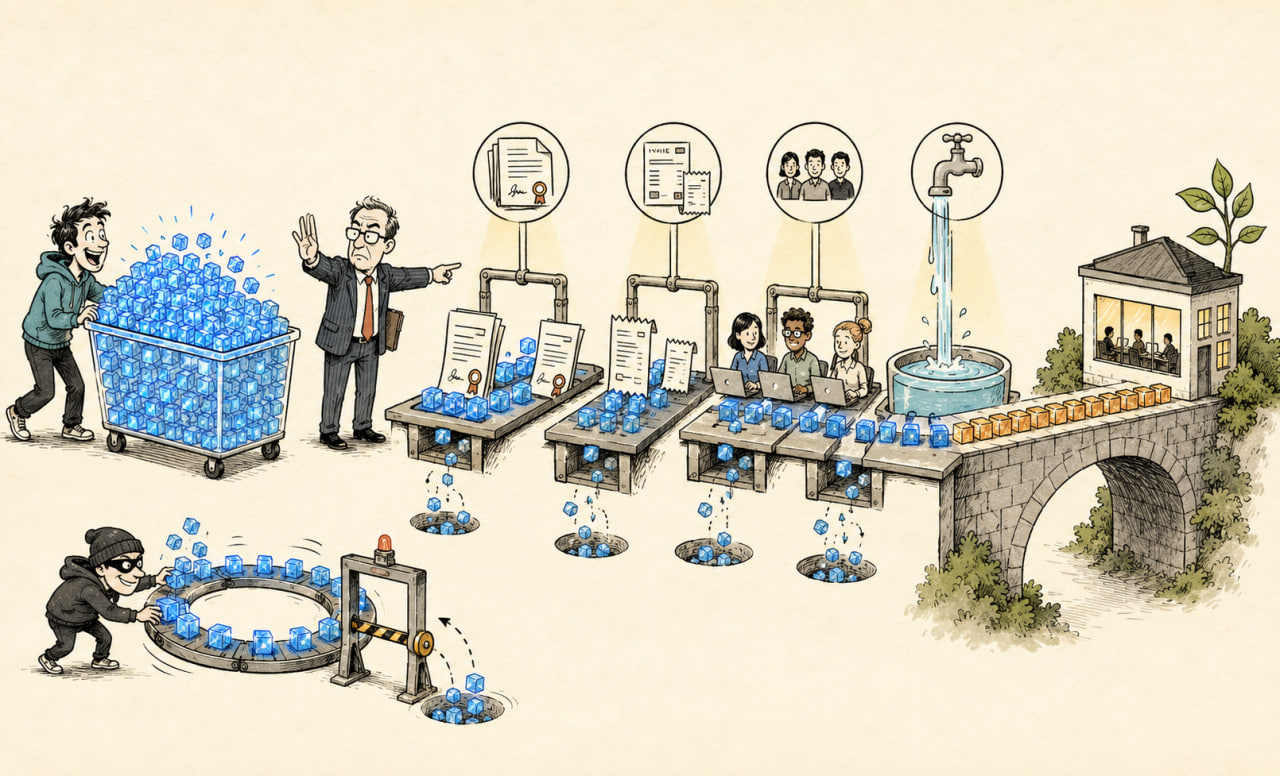
Traditional banks often struggle to underwrite asset-light AI businesses. A company may have few buildings or conventional machines, yet possess growing API usage, signed compute contracts, recurring software customers, and accounts receivable.
China’s Token Loan concept attempts to bring those operating signals into a conventional credit process.
The token itself does not create collateral value. The economic value comes from the customers, contracts, revenue, and verifiable business activity behind the usage record.
How the Chinese Product Is Structured
According to public reporting, the Bank of China product can use contract value and token-consumption allowances when determining a facility. Credit support may include:
- unsecured business credit;
- accounts-receivable pledges;
- purchase-order financing;
- corporate guarantees;
- traditional collateral;
- combinations of the above.
The target market can extend beyond foundation-model developers to compute suppliers, AI application companies, and service providers.
New businesses without long financial histories may still need evidence from a predecessor operating company, signed orders, guarantees, or other support. The product is therefore not an automated loan issued simply because a dashboard shows a large token count.
Banks still review creditworthiness, contracts, repayment capacity, and security. Token data is an additional underwriting input.
Tokens Are Evidence of Activity, Not Collateral
The name “Token Loan” can be misleading. Model tokens generally cannot be independently transferred, sold, or liquidated like a financial asset.
High token consumption proves only that an AI service is being used. It does not prove that the usage is profitable.
Tokens may be consumed by:
- free trials;
- internal testing;
- failed requests and retries;
- inefficient or looping agents;
- subsidized customer programs;
- research products that have not generated revenue.
Token records become more meaningful when they reconcile with contracts, invoices, receivables, bank statements, and paying customers.
| Token signal | What a lender still needs to verify |
|---|---|
| Usage growth | Are paying customers responsible for the increase? |
| Token production | Does it correspond to a real compute service? |
| API volume | Does it produce recognized revenue? |
| Agent tasks | Are tasks completed successfully and economically? |
| Token settlements | Do settlements become cash flow? |
| Long-term compute contracts | Can the customer perform its obligations? |
Why Did This Product Appear in China?
The Guangzhou pilot did not emerge in isolation. It is connected to local efforts to develop compute, models, data services, and AI applications. Haizhu District introduced broader measures covering token production, circulation, consumption, applications, finance, and overseas services alongside the lending products.
Several features of the Chinese market help explain the experiment.
Banks and local industrial policy work closely together
Local governments want to support AI companies that may lack traditional collateral. Token activity and compute contracts offer additional signals for evaluating asset-light businesses.
API competition creates more observable usage
Competitive model pricing encourages enterprises to deploy AI in support, productivity, content, and industry applications, creating more data that might be compared with revenue.
Regional pilots can begin at limited scale
A product can be tested with selected banks and borrowers before policymakers decide whether it is reliable enough to expand.
Does the United States Have Token Loans?
The United States does not yet have a widely standardized equivalent for smaller AI companies. But American finance is already innovating elsewhere in the AI stack.
Current structures include:
- GPU-backed loans;
- data-center project finance;
- financing based on long-term cloud leases;
- loans supported by hyperscaler purchase commitments;
- debt backed by servers, chips, and contract receivables.
In 2026, CoreWeave announced a $3.1 billion facility supporting AI infrastructure dedicated to customer contracts. IREN announced $3.65 billion of GPU financing linked to an AI cloud contract with Microsoft. Large data-center financings have also been structured around long-term, investment-grade leases.
The contrast is revealing.
| China’s Token Loan experiment | U.S. AI infrastructure finance |
|---|---|
| Focuses on usage, orders, and receivables | Focuses on GPUs, facilities, and long-term leases |
| Targets portions of the SME AI supply chain | Primarily serves large infrastructure projects |
| Regional policy and banks work together | Banks, private credit, bonds, and project finance participate |
| Token data supplements credit analysis | Assets and major customer commitments support credit |
| Early regional trial | Individual transactions can reach billions of dollars |
China is asking whether AI usage can become a credit signal. The United States is asking whether GPUs and contracted cloud revenue can become a new infrastructure asset class.
Why the United States May Need an Application-Layer Credit Product
The United States leads in models, chips, and cloud platforms, yet many smaller AI companies still struggle to finance working capital.
An AI software company may have growing enterprise customers, repeat API usage, contracted revenue, high retention, and predictable inference demand—but few conventional assets to pledge.
Venture capital can finance growth but dilutes ownership. Traditional banks may not understand the relationship between model usage and software revenue.
A lender that can verify model usage, customer contracts, and cash flow could create a product between conventional credit and venture funding. Possible market-friendly names include:
- AI Usage-Based Credit;
- Inference Revenue Financing;
- AI Working-Capital Facility;
- Compute Receivables Financing;
- Model-Usage-Backed Lending.
The name matters less than building a credible method for converting AI operations into auditable underwriting data.
What the U.S. Must Solve Before Token-Based Credit Can Scale
1. Standardized token accounting
Different models tokenize the same content differently. Providers also distinguish among input, output, caching, images, audio, video, and tool calls. A raw token count cannot be compared across borrowers without model, price, and workload context.
A minimum reporting standard would need provider, model version, input and output, cache activity, multimodal usage, price, discount, timestamp, workload type, and customer-payment status.
2. Independent verification
A borrower can generate its own activity logs or temporarily increase usage. Lenders should not rely only on company-prepared reports.
Cloud providers, model vendors, payment processors, or independent auditors may need to provide aggregated, verifiable records that detect circular usage, related-party activity, and subsidized demand.
3. A distinction between consumption and value
More token consumption can indicate growth—or inefficiency. Misconfigured agents retry, inefficient models require longer context, and malicious traffic raises costs.
Better credit metrics might include:
- revenue per million tokens;
- gross margin per completed task;
- token cost as a percentage of revenue;
- customer renewal rates;
- successful task-completion rates;
- growth adjusted for retries and waste.
4. Price and technology stress testing
Token prices can fall quickly. A high-value inference contract may become less profitable after model price cuts, open-model substitution, higher GPU costs, or changes in customer behavior.
Underwriting should test API-price compression, lost customers, rising infrastructure cost, provider changes, longer contexts, and more expensive agent workflows.
5. Customer and model concentration
A borrower dependent on one customer or one model provider can suffer an immediate cash-flow shock. Lenders need to understand customer concentration, model-provider concentration, contract duration, portability, and the borrower’s ability to switch models.
6. Privacy-preserving audit
Usage logs can reveal customers, product growth, and user behavior. Detailed prompts may contain confidential or personal data.
A verification system should prove that usage and revenue are real without requiring lenders to read customer prompts. Aggregated reporting, encrypted audits, privacy-preserving computation, and potentially zero-knowledge proofs could become important.
7. Clear legal treatment
Regulators and market participants will need to determine how model receivables, API credits, usage records, GPU assets, and cloud contracts fit within secured lending, consumer protection, privacy, and securities law.
A business loan should remain regulated as credit. A product sold to retail investors with a promised share of token-related returns may raise very different legal questions.
The Risks China Has Already Identified
The early discussion around China’s Token Loan highlights three issues that American lenders should also consider.
Usage can be manipulated
Related accounts, internal jobs, or circular calls can manufacture growth unless an independent party verifies the data.
Usage can be “spiky”
A project may create a temporary surge and then disappear. Lenders need recurring customers and durable revenue rather than one peak month.
Token prices can decline
Efficiency and competition can reduce the revenue associated with a fixed token volume. Credit models must update instead of treating today’s economics as permanent.
The U.S. must also watch rapid GPU depreciation, construction delays, customer concentration, and circular financing among chip suppliers, cloud companies, AI developers, and lenders.
A Practical Road Map for an American Pilot
Stage 1: Start with contracts and receivables
Base lending on real customer agreements, invoices, receivables, and bank statements. Use token data only as a supplementary signal.
Stage 2: Connect verified provider data
With borrower authorization, cloud and model providers could transmit aggregated usage and settlement information directly to a lender.
Stage 3: Build industry benchmarks
Customer support, coding, marketing, and analytics need different efficiency ranges. A single benchmark cannot evaluate every AI company.
Stage 4: Create dynamic credit lines
Facilities could expand when verified usage, paying customers, and margins improve—and contract when churn, waste, or anomalous calls rise.
Stage 5: Standardize only after loss data exists
A secondary market for AI receivables should come only after verification methods and default histories mature. Token volume alone is not a safe basis for securitization.
Could Tokens Become the AI Era’s New Electricity Meter?
Industrial lenders have long used orders, inventory, and sometimes power consumption to understand whether a factory is operating. Digital lenders use payments, subscriptions, and software activity.
Token usage could become another operating indicator. A company consuming tokens may be running a support system, coding agent, research platform, or automated workflow. The signal gains credit value only when the activity produces dependable revenue.
A future AI credit model might combine:
- power and compute usage;
- GPU utilization;
- token activity;
- task-completion rates;
- customer contracts and receivables;
- subscription retention;
- margin per token or task;
- provider concentration and agent risk.
Tokens would not become money. They would function more like a production metric alongside cloud usage, software activity, and contracted revenue.
The Real Lesson for the United States
The most important feature of China’s experiment is not that banks have assigned a price to tokens. It is that lenders are beginning to learn how AI companies produce value.
The United States is further ahead in GPU-backed lending, data-center debt, and financing large cloud contracts. But a gap remains in working-capital products for smaller AI software and service companies.
Two parallel markets could eventually emerge:
- upstream infrastructure finance based on GPUs, power, facilities, and long-term cloud contracts;
- downstream operating finance based on verified AI usage, software orders, recurring revenue, and compute receivables.
Selected sources
- Guangzhou Daily: Guangdong’s Token-economy financial product launch
- IT Home: Initial RMB 28 million Token Loan trial
- SEC filing: CoreWeave $3.1 billion HPC-backed facility
- IREN: $3.65 billion GPU financing
- J.P. Morgan: Financing U.S. AI infrastructure and data centers
This article is informational and does not provide investment, lending, legal, tax, or financial advice. Product terms, reported figures, and regulatory treatment may change. “Token Loan” refers to reported business-lending pilots in China and should not be confused with cryptocurrency lending.