AI Security & Infrastructure
As AI Token Traffic Explodes, Why CDNs Are Becoming the First Line of Defense
Content delivery networks are evolving from performance infrastructure into an important security and cost-control layer between users, agents and expensive AI inference systems.
Generative AI is creating a new category of internet traffic.
Traditionally, a content delivery network, or CDN, cached webpages, video and software files so users could access online services faster. In the AI era, traffic is no longer limited to downloading content. Users, agents and applications continuously send requests to models and receive large streams of tokens in return.
As model calls multiply, CDNs, edge networks and API gateways are taking on a different role. They are no longer only performance tools. They are becoming an important layer for protecting AI interfaces, controlling token costs and identifying abnormal traffic.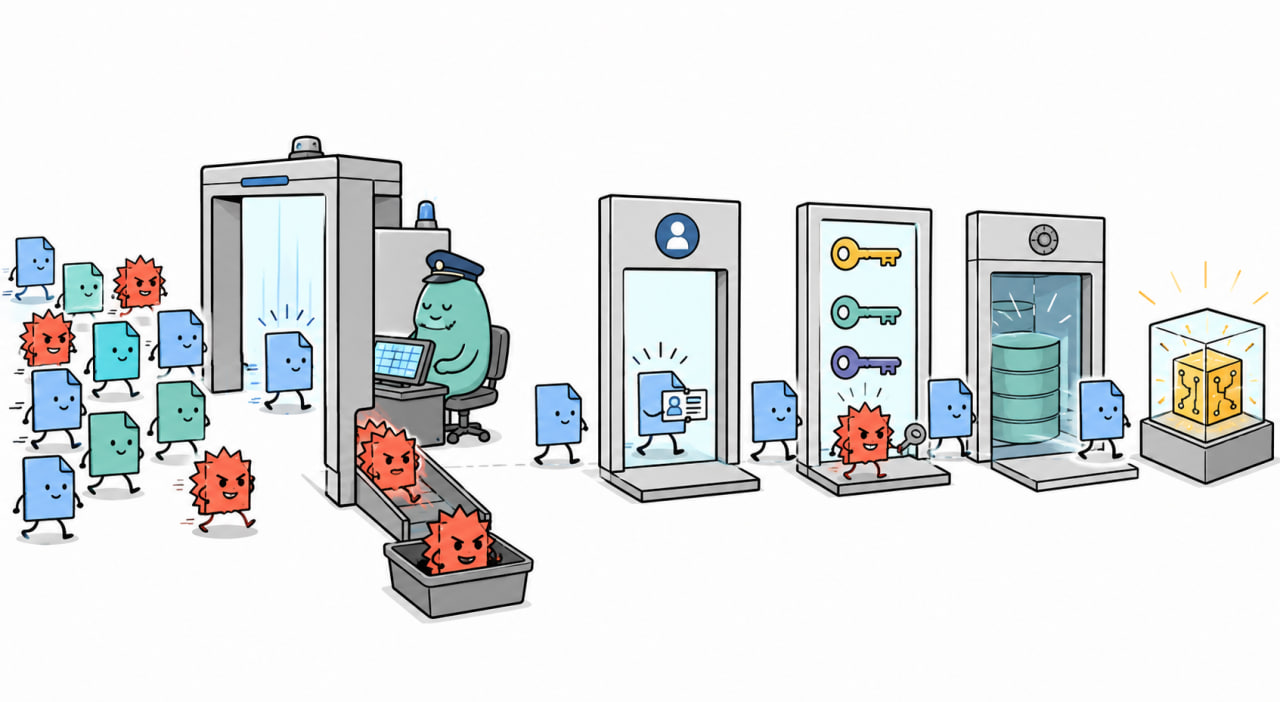
Models, identity systems, cloud platforms, application code and data permissions can all be attack surfaces. The more accurate claim is that the network edge is becoming AI security’s first line of defense—not its only line.
Why Are Tokens Becoming a Security Target?
An AI token is not a digital asset that can be stored in a wallet. It is a unit used to measure how a model processes input and generates output, and it is often directly connected to API charges.
Attackers are generally not trying to steal an isolated token. They are targeting the access rights and computing resources surrounding token usage:
- !Stealing API keys and making model calls through a corporate account;
- !Taking control of an agent and causing it to perform unauthorized actions;
- !Using automated requests to consume tokens and generate a large bill;
- !Using prompt injection to persuade a model to expose sensitive data;
- !Deploying bots to scrape outputs or evade usage limits;
- !Launching denial-of-service attacks against inference systems.
These attacks often appear first as unusual network activity: a sudden jump in requests, rapidly changing sources, behavior that differs from normal users, or one account consuming excessive computing resources in a short period.
CDNs and edge security platforms sit in front of the AI system. That position allows them to identify some of these warning signs before the traffic reaches the model.
In the U.S., AI Security Is Moving Toward the Network Edge
U.S. businesses are rapidly integrating generative AI into search, customer service, financial services, healthcare administration, coding tools and internal knowledge systems. Model APIs are becoming a valuable new attack surface at the same time.
A malicious or unauthorized call can create three broad types of loss:
Direct cost
A stolen API key can consume large numbers of tokens in a short time, leaving the account owner responsible for the bill.
Data risk
An agent connected to corporate files, customer information or internal systems may disclose information because of prompt injection or poor permission settings.
Operational risk
High-volume malicious traffic can occupy inference capacity, slow service for real customers or make a critical application unavailable.
Cloud and cybersecurity providers are therefore combining web application firewalls, API security, bot management, identity checks, rate limits and DDoS protection more closely. A CDN must do more than deliver content quickly. It increasingly helps determine who is allowed to connect, whether the usage pattern looks normal and whether a request should enter an expensive inference system at all.
What Can a CDN Actually Protect?
1. Filter traffic before it reaches the model
If every request goes directly to a GPU cluster, the company may incur computing costs before determining whether the traffic is malicious. Edge platforms can identify known attack sources, abnormal bots and repetitive requests closer to the user, reducing unnecessary model calls.
2. Prevent token costs from spiraling out of control
Traditional websites often limit requests per second. AI services also need to consider how many tokens each call could consume. Dynamic limits can combine account identity, IP address, device, region and usage history to prevent one user—or one compromised key—from generating an enormous bill.
3. Mitigate DDoS and resource-exhaustion attacks
A single AI inference request can cost far more than a standard webpage request. An attacker may not need to saturate bandwidth; repeatedly submitting complex prompts may be enough to occupy GPU time. A CDN can absorb large network attacks and block some compute-exhaustion traffic at the edge.
4. Protect API and agent entry points
Agents increasingly use APIs to access databases, payment systems, email and enterprise software. Edge security can inspect identity tokens, validate request sources, restrict unusual calls and forward suspicious behavior to a security team for review.
5. Provide visibility across regions
Large AI services operate globally, and attacks can originate from many countries and networks. A CDN’s distributed edge nodes can reveal broader traffic patterns that would be invisible in the logs of any single server.
What Can’t a CDN Solve?
A CDN can filter network traffic, but it cannot replace a complete AI security program.
It generally cannot determine whether a model answer is a hallucination or automatically correct bias in training data. If an organization grants an agent excessive privileges, even a request from a legitimate user can trigger dangerous actions. Prompt injection, jailbreaks and sensitive-data exposure also require application-layer defenses, model evaluation and permission isolation.
A broader AI security program should include:
- Secure management of API keys and identity credentials;
- Least-privilege access and tiered authorization;
- Model input and output inspection;
- Approval and auditing of agent tool calls;
- Redaction and encryption of sensitive data;
- Alerts for abnormal token consumption and billing;
- Regular red-team testing and incident-response exercises.
A Useful Analogy
A CDN is like the first security checkpoint at an airport. It can intercept obvious threats and manage the flow of people, but it cannot replace aircraft maintenance, pilot training or air-traffic control.
Europe and China Are Converging on the Same Question
European AI regulation places greater emphasis on data protection, platform responsibility and transparency for high-risk systems. An AI company operating in Europe must also consider privacy law, cross-border data transfers and log-retention requirements when processing network traffic. The location of CDN nodes, the information they record and the access granted to security vendors can all become compliance issues.
China offers another relevant international example. It has a large internet population, a substantial cloud market and a fast-growing AI application ecosystem, along with cybersecurity rules spanning telecommunications networks, cloud platforms and content services. Regulators continue to emphasize critical information infrastructure, data security and the management of generative AI services.
A company deploying a global CDN or AI interface in China must account for local data rules, cross-border access, registration requirements and network architecture. For American businesses, the example illustrates that AI traffic security is not only technical; it is closely tied to policy and data rules in each jurisdiction.
Regulators in the United States, Europe and China are confronting the same central question: when an AI service can automatically call models, process personal information and act in the real world, who is responsible for abnormal access, data leakage and automated decisions?
What New Opportunities Will Token Security Create?
Growing token traffic creates risk, but it also creates new products and careers.
| Cybersecurity firms | Develop defenses that evaluate prompt complexity, token consumption and agent behavior—not only request counts. |
| CDNs and clouds | Combine delivery, inference caching, model routing, identity and security policy into a unified service. |
| Developers | Build token-cost monitoring, API-key management, agent authorization and automated auditing tools. |
| Everyday users | Protect API credentials, review usage records, enable multifactor authentication and set spending limits and alerts. |
For ordinary users, the realistic opportunity is not speculation in an asset that happens to be called a token. It is understanding the security practices required to use paid AI services safely.
The Real Core Is Not the CDN—It Is Controllable AI Traffic
The larger the token economy becomes, the more valuable security around model calls will be. CDNs matter not because they solve every AI risk, but because they control a critical passage: the network entrance between a user request and model inference.
The next phase of AI security will involve more than keeping intruders out of servers. Systems will need to determine whether each call comes from a real user, whether that user has the correct permissions, whether the request may expose data and whether the tokens it consumes are proportionate to the value of the task.
From that perspective, CDNs are evolving from content-delivery infrastructure into an AI traffic-control layer. Providers that can safely and accurately filter massive volumes of model requests without adding substantial latency may occupy an important position in the next stage of the token economy.
Reliable AI requires CDNs, identity systems, API security, model safeguards, data governance and human oversight to work together. The CDN is the first line of defense—not the last.