Bitcoin Miners Are “Switching Sides”: Forget Mining—They’re Working for AI Now
Old mining rigs, expensive electricity, and the race to turn power-hungry crypto sites into AI infrastructure.
Friends, has Bitcoin mining suddenly become the side hustle, while working for AI is the real business?
A few days ago, a friend in Texas was cleaning out his garage when he uncovered a “mining rig” he had bought three years earlier. He had spent nearly $5,000 building it. It made him some money when the market was hot, but after crypto prices fell, mining difficulty climbed, and the machine started sounding like an industrial vacuum cleaner, he shut it down and left it in the corner to collect dust.
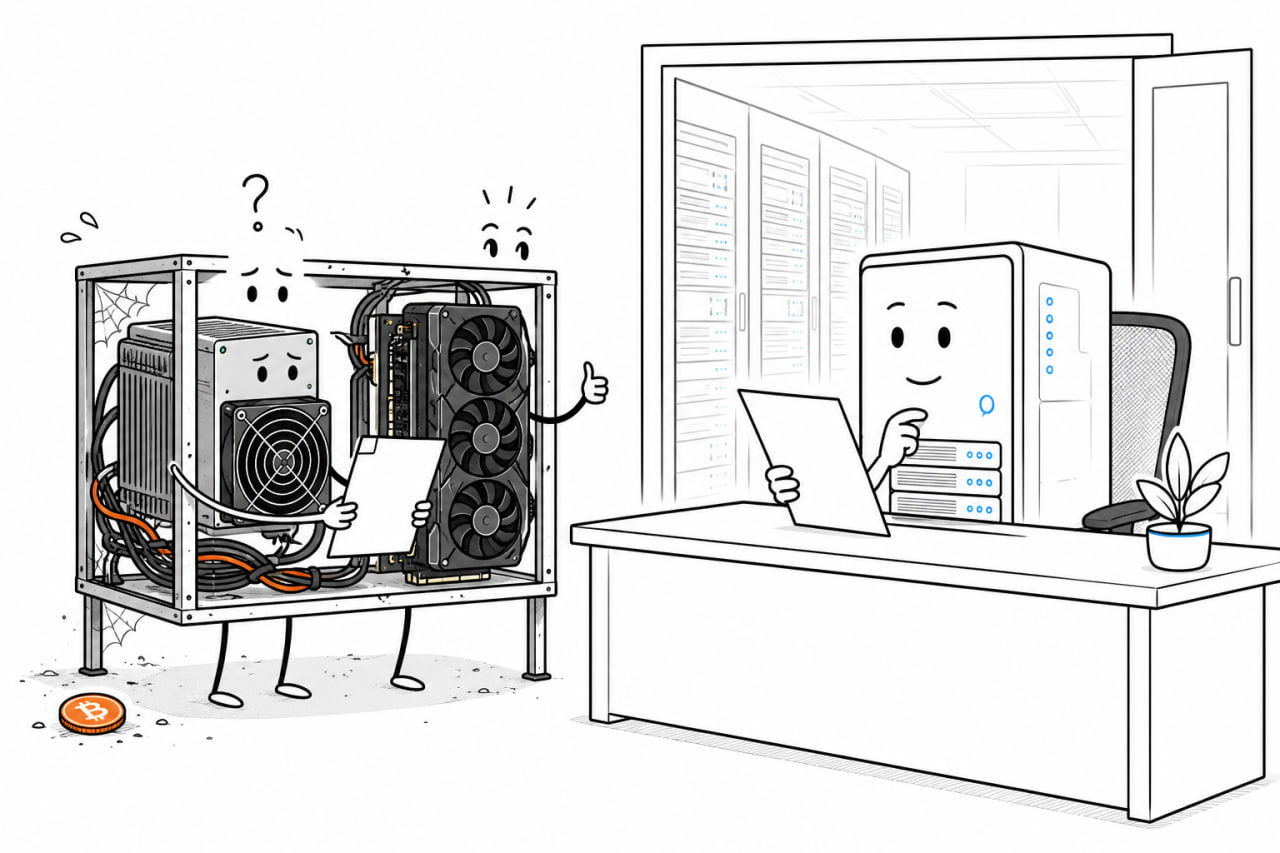 He thought about listing it on Facebook Marketplace. Then he checked the prices of similar used machines and immediately gave up. It was worth so little that he figured he might as well keep it as a souvenir.
“AI companies are desperate for computing power, right? Could I stop mining crypto with this thing and use it to run AI jobs instead?”
At first, the idea did not sound completely crazy.
The crucial distinction
If the machine is an Antminer-style ASIC built specifically for Bitcoin mining, it generally cannot be used to train AI models or generate images. If it is an old GPU rig—the kind many people once used to mine Ethereum—it may have a second life as an AI server.
My friend dug out the original specifications. Fortunately, his machine was not a Bitcoin ASIC. It was a GPU rig equipped with several NVIDIA graphics cards. The hardware was no longer cutting-edge, but the GPUs could still handle some image-generation, lightweight inference, and rendering workloads. So he began looking at GPU marketplaces available to U.S. hosts, such as Vast.ai, to see whether he could rent out the idle cards by the hour.
The prices on these platforms are not fixed. What a GPU can earn depends on the model, available VRAM, CPU, system memory, storage, internet speed, and overall reliability. Whether anyone actually rents it depends on real-time supply and demand. An older system with limited VRAM or frequent downtime can sit on the marketplace for days without receiving a job.
The Power Bill Changes Everything
Once my friend opened a calculator, he realized that the important number was not the advertised hourly rate. It was what remained after paying for electricity.
According to the U.S. Energy Information Administration, average U.S. electricity prices in 2025 were about 17.30 cents per kilowatt-hour for residential customers, 13.41 cents for commercial customers, and 8.62 cents for industrial users. The differences between states are even larger. Power can be relatively inexpensive in some energy-producing states, while customers in Hawaii, California, and parts of the Northeast often pay much more.
A simple electricity calculation
3 kW × 24 hours × $0.15 = $10.80/day
That does not include cooling, internet service, platform fees, repairs, or hardware depreciation.
If the machine is rented for only a few hours a day, its revenue may not even cover the power bill. So while the story sounds like an old mining rig getting a second life, it is really a shift from one compute business to another. Profit still comes down to hardware efficiency, electricity prices, and utilization.
Big Bitcoin Miners Have Already Started Moving
Here is where the story gets more interesting: hobbyists are not the only ones exploring this idea. Major U.S. Bitcoin mining companies have already started moving in the same direction.
After Bitcoin’s fourth halving in 2024, the block reward fell from 6.25 BTC to 3.125 BTC. The reward was cut in half, but electricity, maintenance, and hardware costs were not. Older machines came under even more pressure, pushing some mining companies to look at the rapidly expanding AI data center market.
Core Scientific is one of the clearest examples. Once known primarily as a Bitcoin miner, the company later signed long-term agreements with AI cloud provider CoreWeave. It began converting parts of its mining portfolio into high-performance computing facilities designed to host AI servers powered by NVIDIA GPUs. A series of agreements announced in 2024 expanded the contracted HPC infrastructure between the companies to 382 megawatts.
IREN is also pursuing Bitcoin mining and AI cloud services at the same time. Its AI offering uses data center GPUs such as the H100, H200, and B200. It is not trying to make Bitcoin ASICs run large language models.
What is actually being reused?
Not the old Bitcoin ASICs. The valuable assets are often the power contracts, land, substations, fiber connections, buildings, and cooling infrastructure already attached to the mining site.
In the United States, one of the hardest parts of building a large AI data center is not finding GPUs. It is finding a site that can receive enough electricity soon enough. A new grid connection may take years, while transformers, transmission upgrades, and permits can create additional delays. Bitcoin mining sites may be relatively basic, but many already have access to large amounts of power. That makes them attractive potential partners for AI companies.
AI companies may not want the mining machines at all.
They want the power outlet behind them.
The Conversion Is Not as Easy as It Sounds
Bitcoin mining is relatively tolerant of network latency, and miners can resume working after a temporary shutdown. AI customers expect stable power, fast networking, data security, and much higher service availability. Dense GPU servers may also require advanced liquid cooling, fire protection, backup power, and specialized operations teams. A warehouse that can mine Bitcoin is not automatically a data center ready to serve enterprise AI customers.
The risks are just as real for individuals:
1. Identify the hardware.
A Bitcoin ASIC can usually only continue mining its supported algorithm, be sold secondhand, or be stripped for parts. A GPU has a chance of handling AI, rendering, or other general computing workloads.
2. Calculate the full cost.
A machine may sit idle without customers, and long periods at full load can accelerate hardware wear. Home internet upload speeds, 240-volt electrical circuits, noise, heat, insurance terms, and local rules can all become problems.
3. Never assume guaranteed returns.
Be skeptical of any service promising “guaranteed utilization,” “fixed daily returns,” or a predictable payback period simply for connecting a machine.
The Real Asset May Be the Electricity Connection
Ultimately, this wave of miners “switching sides” is not about putting an AI badge on an old Bitcoin machine. It is about mining companies realizing that their most valuable asset may no longer be the miner—it may be the electricity connection.
In the last cycle, everyone competed for mining machines and hash rate. Now AI companies are competing for power, data center space, and sites that can come online quickly. The next compute race may be decided not only by who has the best chips, but also by who can secure enough affordable, reliable electricity first.
As for the old GPU rig in my friend’s garage, he did not switch it on immediately. He went back and calculated its power consumption, his local electricity rate, and a realistic rental utilization rate.
The heat coming out of the machine is real, and so is the power bill. Whether it can make money by working for AI is something only the numbers can decide.