AI Agents Are Rewriting the Rules: Token Efficiency Is Now a Survival Metric
As AI agents move from prototypes into customer support, coding, research, sales, and operations, token efficiency is becoming a business metric that connects software margins to GPUs, AI factories, and electricity.
In the chatbot era, users submitted a prompt and a model generated one response. Token usage was relatively easy to understand: text went in and text came out.
AI agents work differently. An agent may interpret a goal, create a plan, search the web, read documents, call tools, execute code, inspect results, and retry after failure. A multi-agent system may ask several specialized models to analyze the same problem before a coordinator produces the final answer.
The same task can therefore consume several times—or many times—the tokens required by a conventional question-and-answer interaction.
Once agents enter production workflows, token cost is no longer a small API line item. It can determine whether an AI product scales profitably.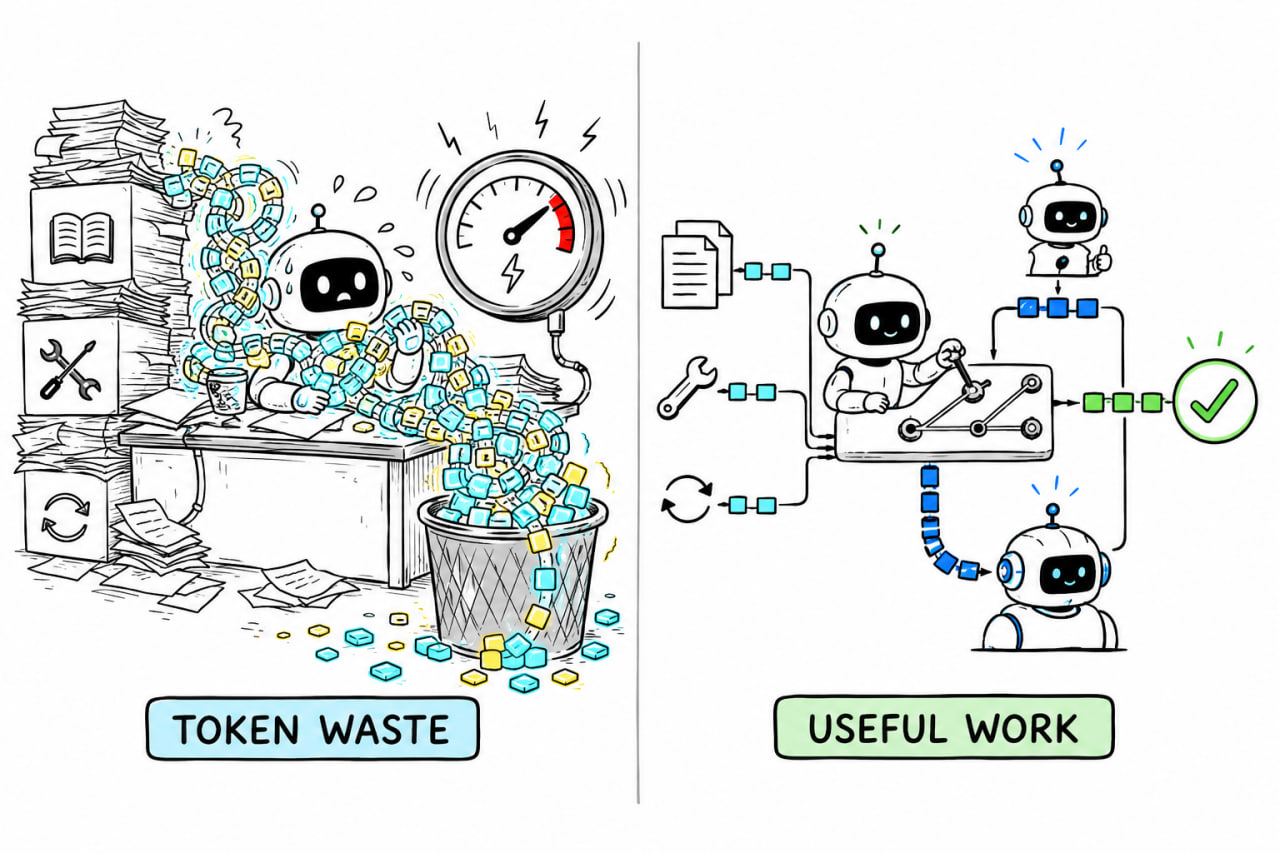
Why AI Agents Drive Token Consumption
A conventional chatbot often performs two steps: receive a prompt and generate an answer. An agent workflow can include:
- understanding the user’s goal;
- reading system instructions and memory;
- analyzing prior context;
- creating an execution plan;
- searching for external information;
- reading webpages and files;
- calling software tools;
- executing code or database operations;
- checking the result;
- replanning after an error;
- repeating selected steps;
- generating the final response.
Nearly every step can create another model call and additional token usage.
A multi-agent architecture may add separate research, data, coding, risk, validation, and coordination agents. If those roles use genuinely different evidence, tools, and criteria, they can improve quality. If they repeatedly read the same information and produce similar conclusions, the system adds cost rather than intelligence.
Cheaper Tokens Do Not Guarantee Cheaper Agents
Per-token API prices have generally declined as chips, inference systems, quantization, caching, batching, speculative decoding, and competition improve.
At the same time, AI workflows are becoming longer and more autonomous. Companies can therefore face an apparent contradiction:
The actual cost of AI operations is better expressed as:
API price affects only one variable. If agents run more steps and execute thousands of times per day, total spending can still rise quickly.
Five Places Where Agents Waste Tokens
1. Context keeps expanding
Agents often carry forward chat history, files, tool results, and execution logs. As a task continues, the context can grow even when much of the information has lost relevance. The model must repeatedly process that material, increasing input cost and potentially distracting attention from critical instructions.
2. Tool results are too long
Search, database queries, logs, code execution, and webpage retrieval can return large amounts of text. Sending everything directly to a model creates waste when the task requires only a few facts.
3. Automatic retries lose control
Retries improve reliability, but an agent without limits may repeat the same failing action. The system appears busy while it consumes tokens and compute without making progress.
4. Multiple agents duplicate analysis
Five agents do not automatically produce five times the value. If they share the same model, evidence, prompt, and decision standard, they can generate highly similar output.
5. The model is stronger than the task requires
Classification, formatting, extraction, and routine routing often do not require the most capable and expensive model. Sending every job to a frontier model reduces system-level efficiency.
The U.S. Agent Ecosystem Is Entering an Efficiency Race
The United States has one of the most active AI agent ecosystems. OpenAI, Anthropic, and Google are developing tool use, code execution, contextual capabilities, and agent-development systems.
Frameworks such as LangGraph, Microsoft AutoGen, and CrewAI help developers build stateful, multi-step, or multi-agent workflows. These tools lower the barrier to combining models, memory, tools, and orchestration.
Easier construction does not guarantee reliable production. After a prototype reaches customers, companies must manage:
- token cost and latency;
- tool failures and loops;
- data security and permissions;
- hallucinations and verification;
- human escalation;
- auditability and accountability.
The next phase of competition is not simply about whether a model can complete a task. It is about who can complete the task with lower cost, fewer unnecessary tokens, and higher reliability.
Measure Effective Tokens, Not Token Volume
Token usage shows activity, but not necessarily business value. An agent consuming billions of tokens may have many customers—or an inefficient architecture.
More useful operating metrics include:
| Metric | What it reveals |
|---|---|
| Tokens per successful task | How much inference is required to produce one accepted result |
| Token waste rate | The share consumed by failures, repetition, irrelevant context, and discarded output |
| Revenue per million tokens | Whether usage converts into customer revenue |
| Gross margin per task | Profit after models, tools, cloud compute, and human review |
| First-pass completion rate | How often an agent succeeds without retries |
| Human takeover rate | How much automation still requires manual rescue |
| Useful tasks per kilowatt-hour | How application value connects to electricity and AI factory efficiency |
From Token Efficiency to Electricity Efficiency
Tokens do not appear from nowhere. Every inference call relies on accelerators, servers, networking, cooling, and electricity.
When an agent wastes tokens, it does more than increase a software bill. It consumes physical computing capacity and electricity inside an AI factory.
If an agent loops at the final stage, all upstream energy and equipment are supporting unproductive work.
A competitive AI factory should measure more than token throughput:
- effective tokens per kilowatt-hour;
- successful tasks per GPU;
- energy consumed per completed task;
- customer acceptance of output;
- revenue generated from inference activity.
AI factories may gradually compete on value density rather than compute scale alone.
Eight Ways to Reduce Agent Token Costs
1. Route tasks to the right model
Use smaller models for routine work and escalate only when complexity or risk requires a more capable model.
2. Compress context
Extract key facts, create stage summaries, and remove information that is no longer relevant. The goal is not to remember everything, but to provide the right information at the right time.
3. Limit tool output
Filter, rank, and summarize search results, logs, and database rows before passing them to a model.
4. Set budgets and stopping conditions
Every agent task should have limits on:
- tokens and model calls;
- tool calls and retries;
- runtime;
- completion criteria;
- conditions requiring human approval.
5. Cache repeated content
System instructions, product documents, policy files, and common knowledge bases are often reused. Caching can reduce repeated input processing.
6. Use conventional software for deterministic steps
Validation, formatting, arithmetic, rules, and database filtering often belong in code. Models should handle the parts that genuinely require language understanding and reasoning.
7. Remove agents that do not add a distinct perspective
Multi-agent value comes from differences in evidence, tools, or evaluation. Merge roles that merely repeat one another, or reserve multi-agent review for higher-risk tasks.
8. Use smaller validators
Review is often easier than generation. A smaller model or deterministic rules may verify formatting, citations, policy compliance, and basic consistency.
What Open Agent Frameworks Change
Open frameworks help teams build agents more quickly. LangGraph emphasizes stateful, controllable execution graphs. AutoGen explores communication among agents. CrewAI offers role-based task orchestration.
These tools can make it easier to choose among model providers, cloud environments, and local deployment. But open source does not automatically prevent context growth, loops, or duplicated calls.
Production-ready agent frameworks increasingly need:
- token and spending controls;
- traceability and cost monitoring;
- failure recovery and permissions;
- model routing and evaluation;
- audit records.
Token Efficiency Could Become a Service-Level Metric
Cloud services traditionally promise availability, latency, and throughput. Agent services may add new operating commitments:
- a maximum token budget per task;
- a target cost range;
- a first-pass completion rate;
- maximum retries and response time;
- confidence or quality thresholds;
- human escalation rates;
- energy consumed per task.
Enterprise customers may reject a model in which an agent decides its own unlimited token consumption. They may prefer successful-task pricing, fixed workflow packages, token budget tiers, outcome pricing, or shared savings.
This would transfer more cost risk to the agent provider—and force providers to improve efficiency.
Result Maximization Is Replacing Token Maximization
Early agent experiments often improved success rates by adding prompts, context, and reasoning steps. That can work in a laboratory, but it is difficult to sustain at commercial scale.
Businesses do not need a model to think for as long as possible. They need it to stop once the result is sufficiently reliable.
If doubling token consumption creates only a negligible quality improvement, the additional inference may have no commercial value.
The objective is neither to maximize tokens nor to minimize them at any cost. It is to find the most productive balance among cost, quality, speed, and risk.
What This Means for the AI Token Economy
Token demand will continue growing: more enterprise workflows will use models and automation.
Waste per task will face pressure: companies will adopt routing, caching, budgets, and deterministic tools.
Smaller models will handle more routine work: frontier systems will focus on difficult and high-value reasoning.
AI factories must prove useful output: GPU count and raw token throughput will not be enough.
Electricity will connect to task value: electricity becomes the starting point of measurable AI production efficiency.
Agent providers will absorb more cost risk: outcome-based pricing will punish inefficient architectures.
Conclusion: AI Advantage Will Depend on Continuous Efficiency
AI agents are moving from prototypes into scaled deployment. The next competitive cycle will not be decided only by model size, context windows, or the number of agents in a workflow.
It will be decided by who can complete more reliable work with fewer resources.
Token efficiency now connects:
- electricity utilization;
- AI factory economics;
- GPU productivity;
- model API pricing;
- agent gross margins;
- customer business value.