AI Infrastructure
The Economics of Computing Are Changing: How “Agent to Token” Is Rewriting AI Growth
As AI agents move from answering questions to completing real work, the industry is beginning to measure infrastructure by the useful tokens—and business outcomes—it can reliably produce.
The AI industry is entering a new phase.
For years, computing growth was measured by servers, racks, chips and data-center capacity. Now that AI agents are moving from systems that can talk to systems that can work, more companies are looking at token generation and consumption as a way to understand how much value an AI service actually creates.
The business logic of computing is therefore shifting from “How much infrastructure can we sell?” to “How many intelligent tasks can this infrastructure support, and how many useful tokens can it produce?”
Every major infrastructure transition has introduced a new way to measure usage. Telecommunications moved from minutes to data traffic. Cloud computing moved from buying servers to paying for resources on demand. In generative AI, the token is becoming an important link between models, infrastructure, applications and economic value.
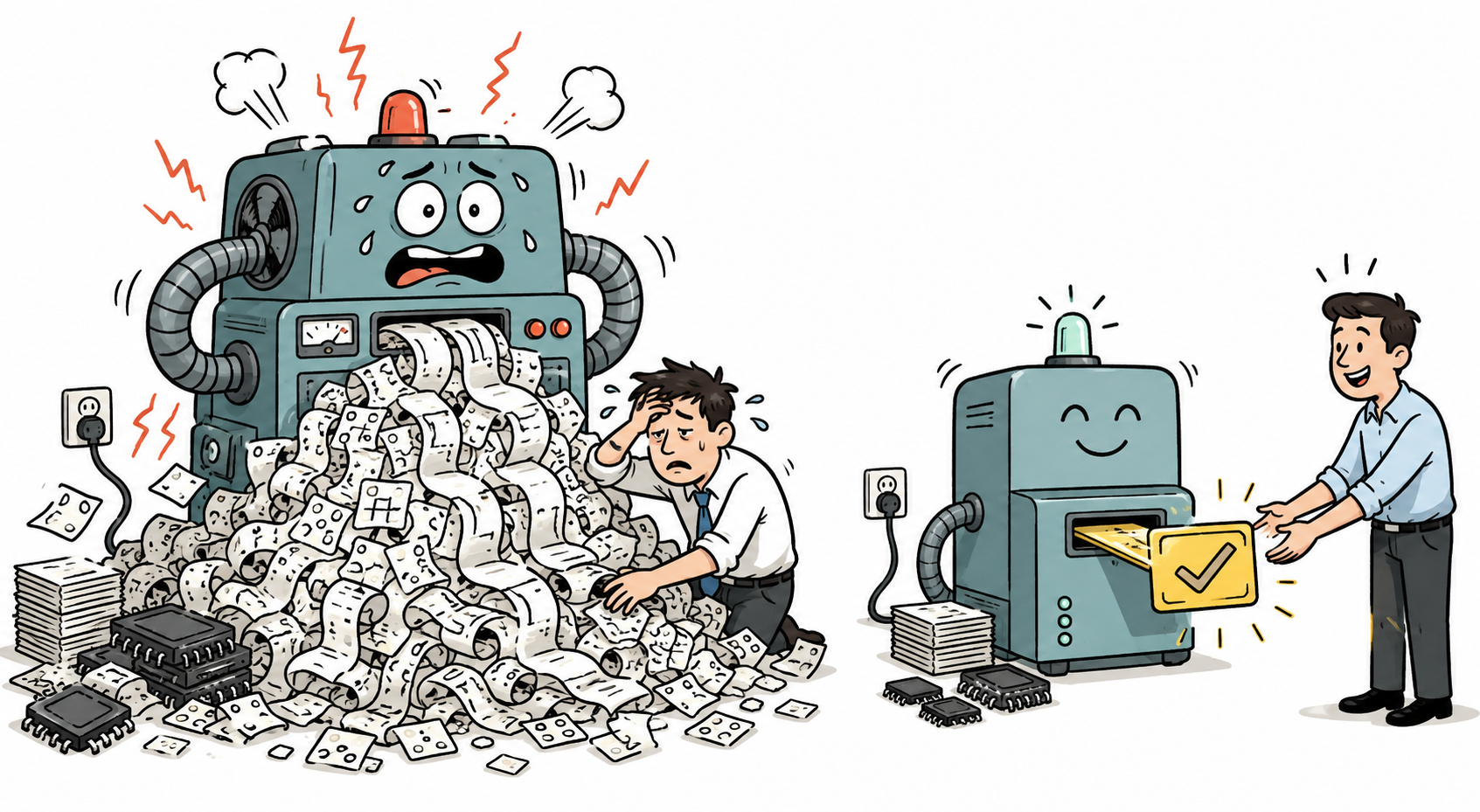
Every Token Has to Become More Efficient
Agents do not consume tokens in the same way as a conventional chatbot.
A simple question may require only hundreds or a few thousand tokens. An agent that plans a task, searches for information, operates software, writes code and checks its own work may require dozens—or even hundreds—of model calls. It continues reasoning, correcting and executing in the background, which increases context length, inference load and total token consumption.
This is increasingly visible in the United States, where companies are introducing agents into customer service, software development, financial analysis, cybersecurity, healthcare administration and internal knowledge management. Their practical questions are no longer limited to model size:
- ✓How many useful tokens can each dollar generate?
- ✓How much computing power does each completed task consume?
- ✓Can response times support real-time workflows?
- ✓Are the outputs accurate, secure and auditable?
- ✓Do model calls translate into measurable business value?
From this perspective, a token is more than a unit of model input or output. It is becoming a common language for measuring the efficiency of AI infrastructure.
China provides a useful international comparison. Public industry reports have projected continued growth in the country’s intelligent-computing and data-center markets. Estimates differ because research firms use different definitions and time frames, but the underlying trend is global: as agent adoption grows, a data center’s value will increasingly depend on how many high-quality tokens it can produce reliably and at low cost—not simply how many servers or megawatts it controls.
From Data Input to Token Production
Data-center competition once revolved primarily around land, electricity, racks, networks and server counts. In the agent era, those benchmarks are changing.
1. From peak compute to token throughput
Two systems with the same number of GPUs can produce very different results depending on model architecture, quantization, inference engines, caching and workload scheduling.
2. From generic infrastructure to application intelligence
High-value services do not come from GPUs alone. They emerge from the combination of models, proprietary data, computing platforms and real business workflows.
3. From individual facilities to distributed compute networks
Training, inference and storage can run in different locations, with workloads routed according to electricity prices, network latency, chip availability and compliance requirements.
For U.S. companies, the transition is also shaped by grid capacity, GPU acquisition costs, data privacy, export controls and differences in state regulation. “How much compute can we provide?” is only the starting point. “At what cost, latency and reliability can we produce useful tokens?” is much closer to the business question.
“Agent to Token” Opens the Door to New Pricing Models
One direct result of Agent to Token is a redesign of how AI services are priced.
Most generative-AI platforms still charge for input and output tokens, while some enterprise services use seats, API calls or subscription tiers. But when an agent can independently complete an entire workflow, token-only pricing may no longer be the most intuitive option for the customer.
The market may move toward hybrid approaches:
- Pricing per completed task;
- Pricing by workflow or agent runtime;
- Outcome-based fees tied to labor saved or business value created;
- Bundled pricing for tokens, model tiers, tool calls and compute;
- Reserved-capacity plans or minimum-use commitments for enterprises.
This does not mean tokens will disappear. They are likely to remain a core measure of underlying resource consumption, while customer-facing products package those costs into task-based or outcome-based prices that are easier to understand.
From GPUs to CPUs: Agent Workloads Need a More Flexible Mix
Not every component of an agent workflow requires the same hardware.
Complex reasoning, large-model generation and high-concurrency inference remain heavily dependent on GPUs. Data retrieval, workflow orchestration, permission checks, tool execution, caching and some lightweight-model workloads may be handled by CPUs, specialized accelerators or mixed architectures.
Future data centers therefore cannot optimize simply by installing the most expensive GPUs. Efficient platforms must route each job dynamically so that the right workload runs on the right chip.
Example
An enterprise security agent might use CPUs to retrieve logs and permissions, call a GPU model to analyze anomalies, and then operate software tools to block a threat or generate a report. The full process combines inference, networking, database access and security auditing. Tokens are one of its most visible computational traces—but not the entire workload.
The value of Agent to Token is therefore not that it reduces every resource to a single number. It gives operators a workload-oriented view: which tokens consume the most resources, which tasks can use smaller models, which calls can be cached and which workflows require stronger real-time guarantees.
The Real Competition Is Not About Producing More Tokens
Higher token output does not automatically create greater business value.
If an agent repeatedly calls a model, produces verbose output and still fails to complete the job, additional tokens only increase cost. What enterprises need are useful tokens: model outputs that improve accuracy, shorten workflows, reduce labor or directly contribute to revenue.
The next generation of infrastructure metrics may therefore include:
| Energy efficiency | Tokens generated per watt of electricity |
| Economic efficiency | Useful tasks completed per dollar |
| Latency | Time to first token and time to completed task |
| Service quality | Availability, accuracy, security and auditability |
| Outcome cost | Total computing expense associated with one business result |
Seen this way, Agent to Token is more than a pricing concept. It represents the industry’s transition from building infrastructure to operating intelligent productivity.
As models and agents become more deeply connected to real business activity, data centers will no longer be viewed only as places that store data and run servers. They will increasingly resemble factories that continuously produce digital intelligence.
The next infrastructure winners will be those that turn energy and hardware into genuinely useful tokens—at lower cost, with higher utilization and more dependable service.